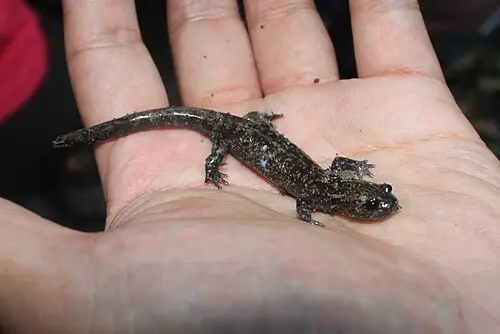
 📸 Photo
Photo: Allen Lyu · CC BY 4.0 · Wikimedia Commons Source
Taiwan Salamander
Hynobius formosanus (Taiwan Salamander · タイワンサンショウウオ)
💡 Everyday Comparisons for Size, Mass & Speed
- 💡 Its total length of 9 cm is slightly longer than the long side of a credit card (85.6 mm) (Comparison).
- 💡 Its prey, pillbugs and earthworms, are creatures also seen in home flowerbeds and garden plots, and this salamander lives by eating those same small creatures in mountain leaf litter (Taiwan Encyclopedia of Life).
Reference standards: coach bus ~12 m, mid-size car ~4.9 m, compact car ~1 t, basketball hoop 3.05 m, credit card 8.56 cm.
📖 1. Overview
The Taiwan Salamander is a hynobiid salamander endemic to Taiwan that lives in the high mountains of central Taiwan. It is an endangered wildlife species under Taiwanese law and is also listed as Endangered (EN, 2020 assessment) on the IUCN Red List.
🦴 2. Anatomy & Morphology
With a snout-to-vent length of about 6 cm and a total length of about 9 cm, its back is dark brown to reddish brown with irregular tan and golden markings. It has 4 toes on both the front and hind feet, parotoid glands behind the eyes, distinct costal grooves along the sides, and secretes white mucus from its skin when startled.
🔍 3. Ecology & Behavior
Active at night and resting under stones, rotting wood, or in soil during the day, it mainly eats small invertebrates such as pillbugs, carabid beetles, and earthworms. It does not autotomize its tail, and Taiwanese salamanders enter water only during the late-winter to early-spring breeding season (National Park Service, Taiwan).
🇰🇷 4. Connection to Korea
No direct record connecting this species to Korea has been found.
📚 Sources & References
- • IUCN Red List EN (2020) — https://www.iucnredlist.org/species/59102/203522803
- • IUCN Red List category EN — latest assessment at iucnredlist.org
- • catalogueoflife.org — 6N2LH
- • iucnredlist.org — 203522803
- • wikidata.org — Q2420802
- • commons.wikimedia.org — File:Hynobius formosanus 21661290.jpg
- • taieol.tw — 72134
- • taiwan.nps.gov.tw — 9532.html
- • Silhouette: PhyloPic — zoosnow · CC0 1.0 (Related taxon silhouette — Onychodactylus fischeri)
Recorded dimensions are widely cited representative estimates from public literature and may vary by study or specimen.