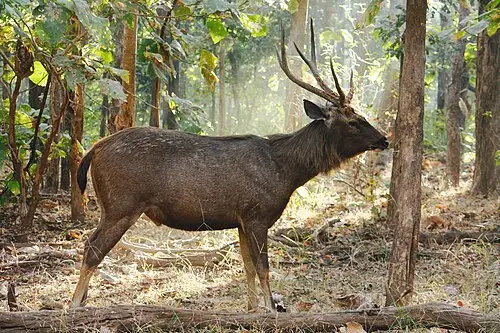
 📸 Photo
Photo: Rashityagi · CC BY-SA 4.0 · Wikimedia Commons Source
Sambar
Rusa unicolor (Sambar · サンバー)
💡 Everyday Comparisons for Size, Mass & Speed
- 💡 People hunt this deer for meat and trade, and it is also kept in zoos worldwide (Animal Diversity Web).
- 💡 A male's maximum weight of 260 kg equals 13 bags of 20 kg rice (Comparison).
- 💡 A male's antler length of 100 cm is the same length as a 1 m ruler (Comparison).
Reference standards: coach bus ~12 m, mid-size car ~4.9 m, compact car ~1 t, basketball hoop 3.05 m, credit card 8.56 cm.
Site-computed relative index from recorded values; not a formal scientific metric.
📖 1. Overview
The Sambar is a large deer living on forested hillsides of South and Southeast Asia, across a wide elevation range from 0 to 3,700 m.
🦴 2. Anatomy & Morphology
It has a short, coarse dark coat with a pale brown to creamy-white underside, and males have a dense mane on the neck. Male antlers have three or four tines, grow up to 100 cm long, and are shed and replaced periodically.
🔍 3. Ecology & Behavior
At dusk or night it browses on leaves, berries, grass, bark, and buds along forest edges. It is mostly nocturnal, lives alone, and is a strong swimmer.
🇰🇷 4. Connection to Korea
No direct record connecting this species to Korea has been found.
📚 Sources & References
- • IUCN Red List VU (2015) — https://www.iucnredlist.org/species/41790/85628124
- • IUCN Red List category VU — latest assessment at iucnredlist.org
- • mammaldiversity.org — 1006325
- • iucnredlist.org — 85628124
- • wikidata.org — Q229337
- • commons.wikimedia.org — File:A Sambal Deer at Peace.jpg
- • animaldiversity.org — Rusa unicolor
- • Silhouette: PhyloPic — Steven Traver · CC0 1.0 (Congeneric silhouette — Cervus elaphus)
Recorded dimensions are widely cited representative estimates from public literature and may vary by study or specimen.