 📸 Photo
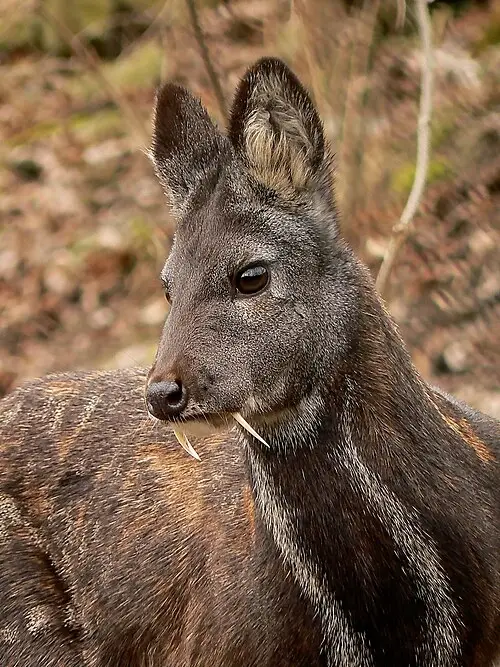
Photo: Николай Усик / http://paradoxusik.livejournal.com/ · CC BY-SA 3.0 · Wikimedia Commons Source
Siberian Musk-deer
Moschus moschiferus (Siberian Musk-deer · シベリアジャコウジカ)
🇰🇷 Class I endangered wildlife (Korea) · Natural Monument (Korea) «Siberian Musk-deer»
💡 Everyday Comparisons for Size, Mass & Speed
- 💡 Musk obtained from the male's musk sac has long been used in medicines and perfumes, leading to heavy hunting, and the species is now listed on CITES Appendix I.
- 💡 An adult weight of about 17 kg is slightly lighter than a 20 kg bag of rice (Comparison).
Reference standards: coach bus ~12 m, mid-size car ~4.9 m, compact car ~1 t, basketball hoop 3.05 m, credit card 8.56 cm.
Site-computed relative index from recorded values; not a formal scientific metric.
📖 1. Overview
The Siberian Musk-deer is a small, hornless deer relative living in mountain forests of East Asia, and males produce musk from a musk sac.
🦴 2. Anatomy & Morphology
Its hind legs are long and powerful while its forelegs are short, and males grow sharp, downward-pointing canine teeth that extend below the jaw.
🔍 3. Ecology & Behavior
It feeds on more than 130 plant species, and lichens make up about 70 % of its stomach contents in winter. It usually gives birth to a single fawn at a time.
🇰🇷 4. Connection to Korea
In Korea, it is protected as Class I endangered wildlife (Korea) and as Natural Monument (Korea) "Sahyangnoru" (Korean name, designated on November 22, 1968).
📚 Sources & References
- • IUCN Red List VU (2015) — https://www.iucnredlist.org/species/13897/61977573
- • 멸종위기 야생생물 Ⅰ급 · 천연기념물 «사향노루» — 국가생물종목록(국립생물자원관) ktsn 120000053345 — https://species.nibr.go.kr/home/mainHome.do?cont_link=009&subMenu=009002&contCd=009002&ktsn=120000053345
- • IUCN Red List category VU — latest assessment at iucnredlist.org
- • Korean protection status: Class I endangered wildlife (Korea) · Natural Monument (Korea) «Siberian Musk-deer»
- • mammaldiversity.org — 1006350
- • iucnredlist.org — 61977573
- • 국가생물종목록(국립생물자원관) ktsn 120000053345 — https://species.nibr.go.kr/home/mainHome.do?cont_link=009&subMenu=009002&contCd=009002&ktsn=120000053345
- • heritage.go.kr — culSelectDetail.do
- • wikidata.org — Q190508
- • commons.wikimedia.org — File:Moschus moschiferus in Plzen zoo (12.02.2011).jpg
- • animaldiversity.org — Moschus moschiferus
- • species.nibr.go.kr — general-search
- • Silhouette: PhyloPic — painting Guo · CC BY 4.0
Recorded dimensions are widely cited representative estimates from public literature and may vary by study or specimen.