 📸 Photo
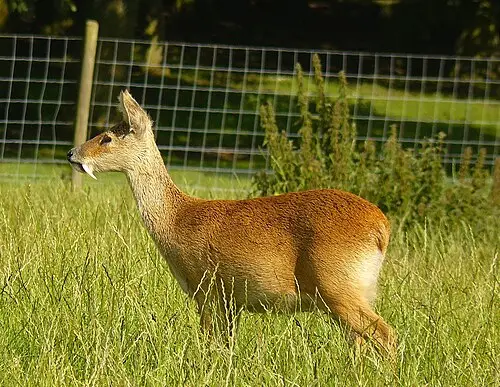
Photo: Altaileopard · Public domain · Wikimedia Commons Source
Water Deer
Hydropotes inermis (Water Deer · キバノロ)
💡 Everyday Comparisons for Size, Mass & Speed
- 💡 It frequently comes into conflict with farmers by eating crops in rice paddies and fields.
- 💡 The male's maximum upper canine length of 52 mm is about twice the diameter of a Korean 500-won coin (about 26.5 mm) (Comparison).
- 💡 Its average weight of 12.9 kg is slightly heavier than a 10 kg bag of rice (Comparison).
Reference standards: coach bus ~12 m, mid-size car ~4.9 m, compact car ~1 t, basketball hoop 3.05 m, credit card 8.56 cm.
Site-computed relative index from recorded values; not a formal scientific metric.
📖 1. Overview
The Water Deer is a small, antlerless deer living on the Korean Peninsula and along the lower Yangtze River in China.
🦴 2. Anatomy & Morphology
Neither sex has antlers, and in males the upper canines grow like tusks up to about 52 mm long. There is a small scent gland in front of the eyes.
🔍 3. Ecology & Behavior
It eats reeds and coarse grasses, selecting tender shoots and herbs. When startled, it bounds away in leaps, and females give birth to two or three fawns at a time, and up to six.
🇰🇷 4. Connection to Korea
A native species occurring naturally on the Korean Peninsula, it is listed as 'Gorani' (Korean name) in the National List of Species of Korea and is Vulnerable (VU) on the IUCN Red List.
📚 Sources & References
- • IUCN Red List VU (2015) — https://www.iucnredlist.org/species/10329/22163569
- • IUCN Red List category VU — latest assessment at iucnredlist.org
- • mammaldiversity.org — 1006288
- • iucnredlist.org — 22163569
- • 국가생물종목록(국립생물자원관) ktsn 120000053353 — https://species.nibr.go.kr/home/mainHome.do?cont_link=009&subMenu=009002&contCd=009002&ktsn=120000053353
- • wikidata.org — Q192573
- • commons.wikimedia.org — File:Hydropotes inermis male.JPG
- • animaldiversity.org — Hydropotes inermis
- • species.nibr.go.kr — general-search
- • Silhouette: PhyloPic — An Ignorant Atheist · CC0 1.0 (Related taxon silhouette — Cervidae)
Recorded dimensions are widely cited representative estimates from public literature and may vary by study or specimen.