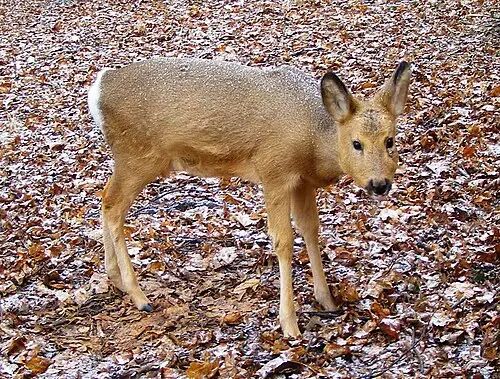
 📸 Photo
Photo: Ivolga ya · CC BY-SA 4.0 · Wikimedia Commons Source
Eastern Roe Deer
Capreolus pygargus (Eastern Roe Deer · シベリアノロジカ)
💡 Everyday Comparisons for Size, Mass & Speed
- 💡 It is hunted in Russia and China for its meat and decorative antlers, and Mongolia sells hunting permits.
- 💡 A male's maximum weight of 48.6 kg is slightly heavier than two 20 kg bags of rice (Comparison).
- 💡 Because it feeds on farm crops, farmers regard it as an agricultural pest.
Reference standards: coach bus ~12 m, mid-size car ~4.9 m, compact car ~1 t, basketball hoop 3.05 m, credit card 8.56 cm.
Site-computed relative index from recorded values; not a formal scientific metric.
📖 1. Overview
The eastern roe deer is a medium-sized deer living in temperate forests of northern Asia, called Noru on the Korean Peninsula.
🦴 2. Anatomy & Morphology
Its hind legs are longer than its forelegs, and the male's antlers measure 28–33 cm in length with three tines. Its coat is grayish brown in winter and reddish orange in summer.
🔍 3. Ecology & Behavior
It eats the leaves, flowers, and stems of over 600 plant species, and also feeds on twigs, mosses, and lichens in winter. It mates in July–September and usually gives birth to twins.
🇰🇷 4. Connection to Korea
An isolated population also lives on Jeju Island (ADW), and ADW notes that populations in both North and South Korea have declined due to poaching and habitat loss. It is listed under the Korean name Noru in the National List of Species of Korea.
📚 Sources & References
- • IUCN Red List LC (2016) — https://www.iucnredlist.org/species/42396/22161884
- • IUCN Red List category LC — latest assessment at iucnredlist.org
- • mammaldiversity.org — 1006287
- • iucnredlist.org — 22161884
- • 국가생물종목록(국립생물자원관) ktsn 120000053348 — https://species.nibr.go.kr/home/mainHome.do?cont_link=009&subMenu=009002&contCd=009002&ktsn=120000053348
- • wikidata.org — Q501491
- • commons.wikimedia.org — File:Косуля 1.JPG
- • animaldiversity.org — Capreolus pygargus
- • species.nibr.go.kr — general-search
- • Silhouette: PhyloPic — painting Guo · CC BY 4.0
Recorded dimensions are widely cited representative estimates from public literature and may vary by study or specimen.