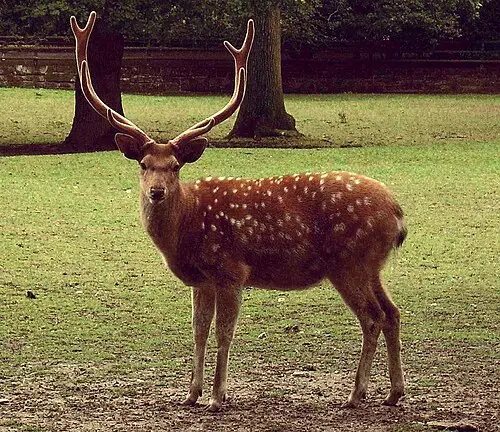
 📸 Photo
Photo: Altaileopard ; modified by Wildfeuer · CC BY-SA 3.0 · Wikimedia Commons Source
Sika Deer
Cervus nippon (Sika Deer · ニホンジカ)
🇰🇷 Class I endangered wildlife (Korea) (subspecies Cervus nippon hortulorum)
💡 Everyday Comparisons for Size, Mass & Speed
- 💡 Because it readily eats soybeans and corn, farmers regard it as a crop pest, while in China its antlers are highly prized in traditional medicine.
- 💡 A male's shoulder height of 1.09 m is similar to the height of a lower-grade elementary school child (Comparison).
- 💡 Its maximum body length of 1.8 m is about two-fifths the length of a passenger car (around 4.5 m) (Comparison).
Reference standards: coach bus ~12 m, mid-size car ~4.9 m, compact car ~1 t, basketball hoop 3.05 m, credit card 8.56 cm.
Site-computed relative index from recorded values; not a formal scientific metric.
📖 1. Overview
A medium-sized deer native to East Asia, called 'flower deer' in Korean because of the rows of white spots on its summer coat.
🦴 2. Anatomy & Morphology
Its coat ranges from chestnut to reddish olive with seven or eight rows of white spots along the back and a large white patch on the rump. Only males grow antlers, which are 30 to 66 cm long with 2 to 5 tines.
🔍 3. Ecology & Behavior
It feeds on grasses, fallen leaves, and shrub foliage, mates in September and October, and gives birth to a single fawn in May or June of the following year. A single male may mate with up to twelve females in one season.
🇰🇷 4. Connection to Korea
East Asia, including the Korean Peninsula, is its native range, and the subspecies Cervus nippon hortulorum is designated as a Class I Endangered Wildlife species in South Korea.
📚 Sources & References
- • IUCN Red List LC (2015) — https://www.iucnredlist.org/species/41788/22155877
- • 멸종위기 야생생물 Ⅰ급 (아종 Cervus nippon hortulorum) — 국가생물종목록(국립생물자원관) ktsn 120000053351 — https://species.nibr.go.kr/home/mainHome.do?cont_link=009&subMenu=009002&contCd=009002&ktsn=120000053351
- • IUCN Red List category LC — latest assessment at iucnredlist.org
- • Korean protection status: Class I endangered wildlife (Korea) (subspecies Cervus nippon hortulorum)
- • mammaldiversity.org — 1006315
- • iucnredlist.org — 22155877
- • 국가생물종목록(국립생물자원관) ktsn 120000053351 — https://species.nibr.go.kr/home/mainHome.do?cont_link=009&subMenu=009002&contCd=009002&ktsn=120000053351
- • 국가생물종목록(국립생물자원관) ktsn 120000212942 — https://species.nibr.go.kr/home/mainHome.do?cont_link=009&subMenu=009002&contCd=009002&ktsn=120000212942
- • wikidata.org — Q190516
- • commons.wikimedia.org — File:Cervus nippon dybowski Solo.jpg
- • animaldiversity.org — Cervus nippon
- • species.nibr.go.kr — general-search
- • Silhouette: PhyloPic — Birgit Lang · CC0 1.0
Recorded dimensions are widely cited representative estimates from public literature and may vary by study or specimen.