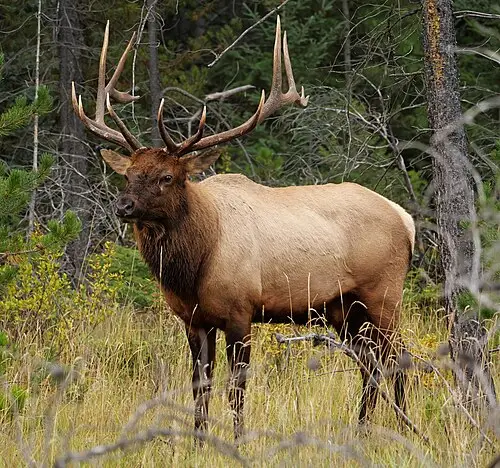
 📸 Photo
Photo: Membeth · CC0 · Wikimedia Commons Source
Wapiti
Cervus canadensis (Wapiti · ワピチ)
💡 Everyday Comparisons for Size, Mass & Speed
- 💡 Its body length of 1.87 m is about four-tenths the length of a passenger car (around 4.5 m) (Comparison).
- 💡 Its shoulder height of 1.24 m is similar to the height of a lower-grade elementary school child (around 1.2 m) (Comparison).
- 💡 During the breeding season, males bugle loudly like horses to call females (National List of Species of Korea).
Reference standards: coach bus ~12 m, mid-size car ~4.9 m, compact car ~1 t, basketball hoop 3.05 m, credit card 8.56 cm.
📖 1. Overview
The Wapiti is introduced in the National List of Species of Korea as the largest deer species living in Korea. It inhabits deep forests far from human settlements.
🦴 2. Anatomy & Morphology
In summer, the coat on the back and outer legs is bluish gray, while in winter the back is grayish brown and the rump patch is orange-yellow. The mane is blackish and the hair tips are black.
🔍 3. Ecology & Behavior
The breeding season runs from early September to early October. Males lower their heads close to the ground, run through the forest following female tracks, and bugle like horses to call females.
🇰🇷 4. Connection to Korea
The entry for Wapiti in the National List of Species of Korea introduces it as Korea's largest deer at a body length of 187 cm and shoulder height of 124 cm, noting that it is distributed in the northern regions of the Korean Peninsula.
📚 Sources & References
- • IUCN Red List category LC — latest assessment at iucnredlist.org
- • mammaldiversity.org — 1006312
- • iucnredlist.org — 55997823
- • 국가생물종목록(국립생물자원관) ktsn 120000053350 — https://species.nibr.go.kr/home/mainHome.do?cont_link=009&subMenu=009002&contCd=009002&ktsn=120000053350
- • wikidata.org — Q180404
- • commons.wikimedia.org — File:Jasper.Wapiti-Hirsch.P1033401.jpg
- • species.nibr.go.kr — mainHome.do
- • Silhouette: PhyloPic — author not recorded · CC0 1.0
Recorded dimensions are widely cited representative estimates from public literature and may vary by study or specimen.