 📸 Photo
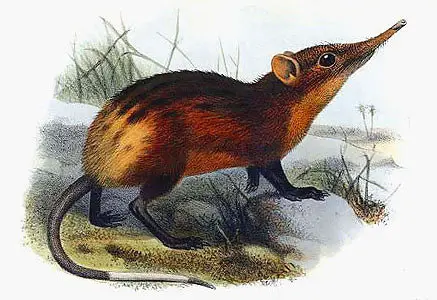
Photo: Joseph Smit · Public domain · Wikimedia Commons Source
Golden-rumped Sengi
Rhynchocyon chrysopygus (Golden-rumped Sengi · コシキハネジネズミ)
💡 Everyday Comparisons for Size, Mass & Speed
- 💡 In northern Kenya, people sometimes trap and eat elephant-shrews.
- 💡 Its weight of 540 g is slightly heavier than a 500 mL bottle of water (Comparison).
- 💡 When startled, it slaps the ground with its hindfeet to make a sound as it flees.
Reference standards: coach bus ~12 m, mid-size car ~4.9 m, compact car ~1 t, basketball hoop 3.05 m, credit card 8.56 cm.
Site-computed relative index from recorded values; not a formal scientific metric.
📖 1. Overview
The Golden-rumped Sengi is an elephant-shrew living only in coastal forests of Kenya, notable for the golden patch on its rump.
🦴 2. Anatomy & Morphology
It probes leaf litter with its long, flexible snout, and has golden fur on its rump and forehead while its feet, ears, and legs are black. Males have a thicker dermal shield under the rump.
🔍 3. Ecology & Behavior
It eats earthworms, millipedes, insects, and spiders. Females give birth to one young at a time after a gestation of about 42 days, and it builds a new nest every 1–3 days.
🇰🇷 4. Connection to Korea
No direct record connecting this species to Korea has been found.
📚 Sources & References
- • IUCN Red List EN (2015) — https://www.iucnredlist.org/species/19705/21287265
- • IUCN Red List category EN — latest assessment at iucnredlist.org
- • mammaldiversity.org — 1000460
- • iucnredlist.org — 21287265
- • wikidata.org — Q1333257
- • commons.wikimedia.org — File:Rhynchocyon chrysopygus-J Smit.jpg
- • animaldiversity.org — Rhynchocyon chrysopygus
- • Silhouette: PhyloPic — Kai Caspar · CC0 1.0 (Congeneric silhouette — Rhynchocyon petersi)
Recorded dimensions are widely cited representative estimates from public literature and may vary by study or specimen.