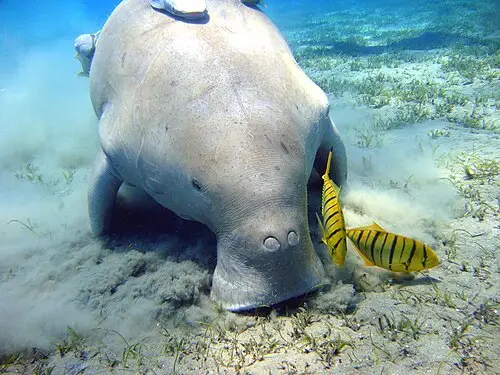
 📸 Photo
Photo: Julien Willem · CC BY-SA 3.0 · Wikimedia Commons Source
Dugong
Dugong dugon (Dugong · ジュゴン)
💡 Everyday Comparisons for Size, Mass & Speed
- 💡 In Malaysia, Dugongs accidentally caught in nets or traps are eaten as a delicacy, and sailors' mermaid legends linked to the Dugong are also noted in ADW.
- 💡 Australia offers Dugong-watching boat tours, while the Philippines and Vanuatu have tours where visitors swim with Dugongs.
- 💡 One individual needs about 0.4 ha (4,000 m²) of seagrass beds per year, which is slightly more than half a soccer field (about 7,000 m²) (Comparison).
Reference standards: coach bus ~12 m, mid-size car ~4.9 m, compact car ~1 t, basketball hoop 3.05 m, credit card 8.56 cm.
Site-computed relative index from recorded values; not a formal scientific metric.
📖 1. Overview
The Dugong is a marine mammal that grazes on seagrass in shallow tropical seas and belongs to the sea cow group.
🦴 2. Anatomy & Morphology
It has no dorsal fin, short paddle-like flippers, and a propeller-shaped tail fluke. Adult males usually have visible tusks, and sensory bristles grow on the upper lip and body.
🔍 3. Ecology & Behavior
It feeds mainly on seagrass and also eats marine algae when seagrass is scarce. After a gestation period of 13–15 months, females give birth to a single calf once every 2.5–7 years.
🇰🇷 4. Connection to Korea
No direct record connecting this species to Korea has been found.
📚 Sources & References
- • IUCN Red List VU (2019) — https://www.iucnredlist.org/species/6909/160756767
- • IUCN Red List category VU — latest assessment at iucnredlist.org
- • mammaldiversity.org — 1000529
- • iucnredlist.org — 160756767
- • wikidata.org — Q129544
- • commons.wikimedia.org — File:Dugong Marsa Alam.jpg
- • animaldiversity.org — Dugong dugon
- • Silhouette: PhyloPic — Matthew Speight · CC0 1.0
Recorded dimensions are widely cited representative estimates from public literature and may vary by study or specimen.