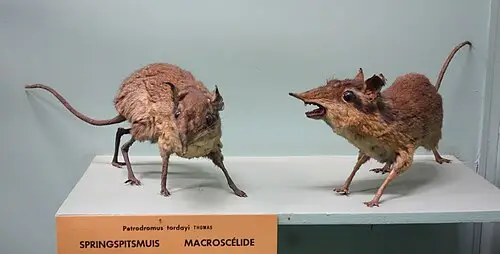
 📸 Photo
Photo: Daderot · CC0 · Wikimedia Commons Source
Four-toed Sengi
Petrodromus tetradactylus (Four-toed Sengi · ヨツユビハネジネズミ)
💡 Everyday Comparisons for Size, Mass & Speed
- 💡 Its average weight of 205 g is about that of an apple (Comparison).
- 💡 By eating large numbers of insects, it helps reduce pest populations and may benefit neighboring farm crops.
Reference standards: coach bus ~12 m, mid-size car ~4.9 m, compact car ~1 t, basketball hoop 3.05 m, credit card 8.56 cm.
Site-computed relative index from recorded values; not a formal scientific metric.
📖 1. Overview
The Four-toed Sengi is a large elephant shrew living in African forests that has four toes on each hind foot.
🦴 2. Anatomy & Morphology
It has four toes rather than five on its hind feet. Its grey to sandy fur is long and soft with hints of orange and yellow and sometimes white rings around the eyes. It has a long, flexible nose, and long slender legs hold its body 3–4 cm off the ground.
🔍 3. Ecology & Behavior
It prefers termites and ants, with insects making up most of its diet alongside a small amount of plant matter. It builds runways through the undergrowth, leaps in long bounds when alarmed, and raps the ground with its hind feet as it runs.
🇰🇷 4. Connection to Korea
No direct record connecting this species to Korea has been found.
📚 Sources & References
- • IUCN Red List LC (2015) — https://www.iucnredlist.org/species/42679/21290893
- • IUCN Red List category LC — latest assessment at iucnredlist.org
- • mammaldiversity.org — 1000458
- • iucnredlist.org — 21290893
- • wikidata.org — Q930150
- • commons.wikimedia.org — File:Petrodromus tetradactylus tordayi - Royal Museum for Ce
- • animaldiversity.org — Petrodromus tetradactylus
- • Silhouette: PhyloPic — author not recorded · CC0 1.0
Recorded dimensions are widely cited representative estimates from public literature and may vary by study or specimen.