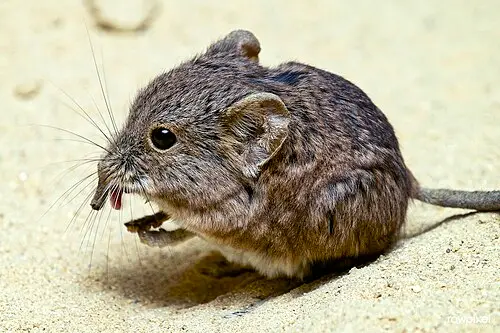
 📸 Photo
Photo: Rawpixel Ltd · CC BY 2.0 · Wikimedia Commons Source
Karoo Round-eared Sengi
Macroscelides proboscideus (Karoo Round-eared Sengi · Karoo Round-eared Sengi)
💡 Everyday Comparisons for Size, Mass & Speed
- 💡 Its weight of 40–50 g is similar to a single egg (about 50 g) (Comparison).
- 💡 Its burrowing is said to turn over soil in ways that may benefit the land.
Reference standards: coach bus ~12 m, mid-size car ~4.9 m, compact car ~1 t, basketball hoop 3.05 m, credit card 8.56 cm.
Site-computed relative index from recorded values; not a formal scientific metric.
📖 1. Overview
The Karoo Round-eared Sengi is a small sengi living in arid parts of Africa, with a long trunk-like nose.
🦴 2. Anatomy & Morphology
Its ears are short and round, and it lacks pale rings around the eyes. Its fur is long and soft—orange, brown, or grayish on the back and paler on the belly. Its tail is hairy, and the first toe on the hindfoot bears a small claw.
🔍 3. Ecology & Behavior
It feeds mainly on insects such as termites and ants along with small invertebrates, and also eats roots, shoots, and berries. Diurnal and solitary, it uses burrows like roads and kicks away debris that blocks the entrance. Females give birth to two young at a time, and newborns can run within a few hours.
🇰🇷 4. Connection to Korea
No direct record connecting this species to Korea has been found.
📚 Sources & References
- • IUCN Red List LC (2015) — https://www.iucnredlist.org/species/45369602/45435551
- • IUCN Red List category LC — latest assessment at iucnredlist.org
- • mammaldiversity.org — 1000457
- • iucnredlist.org — 45435551
- • wikidata.org — Q1130566
- • commons.wikimedia.org — File:Short-eared Elephant Shrew (2014) by Clyde Nishimura. O
- • animaldiversity.org — Macroscelides proboscideus
- • Silhouette: PhyloPic — Kai Caspar · CC0 1.0 (Related taxon silhouette — Rhynchocyon petersi)
Recorded dimensions are widely cited representative estimates from public literature and may vary by study or specimen.