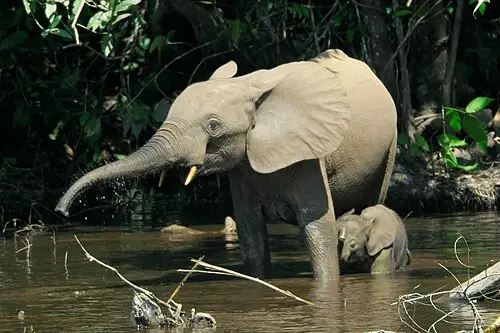
 📸 Photo
Photo: Thomas Breuer · CC BY 2.5 · Wikimedia Commons Source
African Forest Elephant
Loxodonta cyclotis (African Forest Elephant · マルミミゾウ)
💡 Everyday Comparisons for Size, Mass & Speed
- 💡 Its ivory was used for knife handles, combs, and piano keys; although trade is now banned, poaching remains a major threat.
- 💡 Its maximum weight of 6,000 kg is about the weight of four or five passenger cars (Comparison).
- 💡 It damages farms by trampling crops such as sugarcane, grains, and oil palms.
Reference standards: coach bus ~12 m, mid-size car ~4.9 m, compact car ~1 t, basketball hoop 3.05 m, credit card 8.56 cm.
Site-computed relative index from recorded values; not a formal scientific metric.
📖 1. Overview
The African Forest Elephant lives in the tropical rainforests of central and western Africa and is smaller than the African Savanna Elephant.
🦴 2. Anatomy & Morphology
Its ears are rounded, and its tusks are straighter and thinner than those of the African Savanna Elephant, pointing downward to help it move through dense forest. It has 4 toes on each forefoot and 3 on each hindfoot.
🔍 3. Ecology & Behavior
It feeds on the fruits, leaves, bark, and branches of forest trees and supplements minerals from soil. By eating fruit, it plays a vital role in dispersing seeds.
🇰🇷 4. Connection to Korea
No direct record connecting this species to Korea has been found.
📚 Sources & References
- • IUCN Red List CR (2026) — https://www.iucnredlist.org/species/181007989/292481365
- • IUCN Red List category CR — latest assessment at iucnredlist.org
- • mammaldiversity.org — 1000523
- • iucnredlist.org — 292481365
- • wikidata.org — Q189514
- • commons.wikimedia.org — File:Loxodontacyclotis.jpg
- • animaldiversity.org — Loxodonta cyclotis
- • Silhouette: PhyloPic — Evan Hockridge · CC0 1.0
Recorded dimensions are widely cited representative estimates from public literature and may vary by study or specimen.