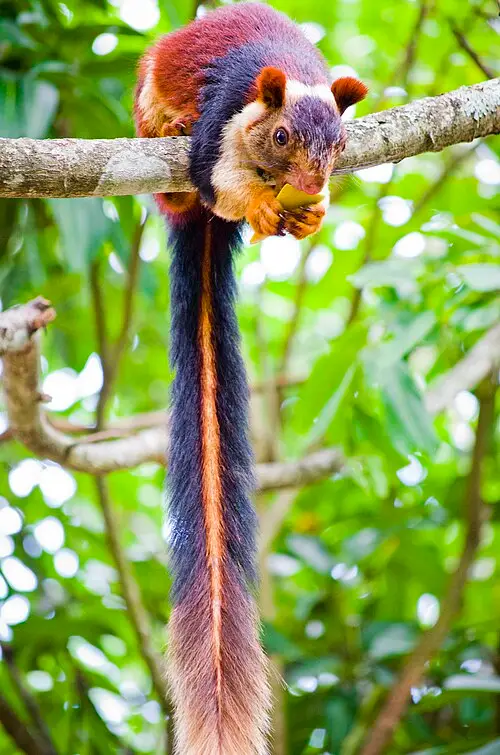
 📸 Photo
Photo: VinodBhattu · CC BY-SA 4.0 · Wikimedia Commons Source
Indian Giant Squirrel
Ratufa indica (Indian Giant Squirrel · インドオオリス)
💡 Everyday Comparisons for Size, Mass & Speed
- 💡 A single leap of 6 m or more is longer than a passenger car (about 4.5 m long) (Comparison). Its maximum body length of 45.7 cm is about 1.5 times a 30 cm ruler (Comparison).
- 💡 Its maximum weight of 3 kg is close to 1/3 of a 10 kg bag of rice (Comparison).
Reference standards: coach bus ~12 m, mid-size car ~4.9 m, compact car ~1 t, basketball hoop 3.05 m, credit card 8.56 cm.
Site-computed relative index from recorded values; not a formal scientific metric.
📖 1. Overview
The Indian Giant Squirrel is a large squirrel that lives high in the trees of moist tropical forests and rarely comes down to the ground.
🦴 2. Anatomy & Morphology
Its back ranges from deep red to brown and its belly is white. It has short, round ears, broad palms, and large, powerful claws for gripping bark, while its body-length tail acts as a counterweight for balance.
🔍 3. Ecology & Behavior
Active and solitary during the day, it eats fruits, flowers, nuts, bark, bird eggs, and insects. It stands on its hind legs to handle food with its forepaws and leaps 6 m or more between trees.
🇰🇷 4. Connection to Korea
No direct record connecting this species to Korea has been found.
📚 Sources & References
- • IUCN Red List LC (2016) — https://www.iucnredlist.org/species/19378/22262028
- • IUCN Red List category LC — latest assessment at iucnredlist.org
- • mammaldiversity.org — 1001608
- • iucnredlist.org — 22262028
- • wikidata.org — Q2668978
- • commons.wikimedia.org — File:The Indian giant squirrel.jpg
- • animaldiversity.org — Ratufa indica
- • Silhouette: PhyloPic — Joseph Smit · Public Domain Mark 1.0 (Related taxon silhouette — Sciurillus pusillus)
Recorded dimensions are widely cited representative estimates from public literature and may vary by study or specimen.