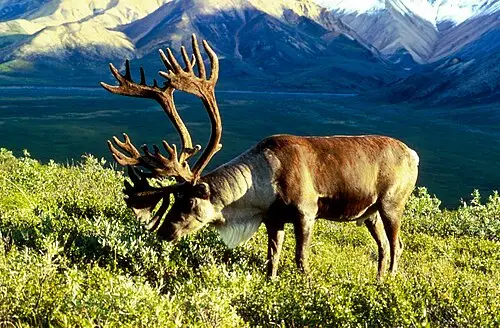
 📸 Photo
Photo: Dean Biggins (U.S. Fish and Wildlife Service) · Public domain · Wikimedia Commons Source
Caribou
Rangifer tarandus (Caribou · トナカイ)
💡 Everyday Comparisons for Size, Mass & Speed
- 💡 The Caribou is widely used for its meat, fur, and antlers, and its domesticated subspecies has been herded by people for thousands of years (Animal Diversity Web).
- 💡 Traveling 5,000 km a year is like going between Seoul and Busan (about 400 km) more than twelve times (Comparison).
- 💡 Its running speed of 80 km/h is 8 tenths of a highway speed limit (100 km/h) (Comparison).
Reference standards: coach bus ~12 m, mid-size car ~4.9 m, compact car ~1 t, basketball hoop 3.05 m, credit card 8.56 cm.
Site-computed relative index from recorded values; not a formal scientific metric.
📖 1. Overview
The Caribou is a deer living in the Arctic tundra and northern coniferous forests that travels farther than any other land mammal. Its domesticated subspecies is the reindeer herded by people.
🦴 2. Anatomy & Morphology
Its hairs are hollow and taper toward the tip, trapping heat and helping the body float well in water. Size and color vary by subspecies, and in some subspecies males are up to twice as large as females.
🔍 3. Ecology & Behavior
In summer it eats willow and birch leaves and sedges, and in winter it feeds heavily on lichens. It travels more than 5,000 km a year, and tens of thousands may gather in summer.
🇰🇷 4. Connection to Korea
No direct record connecting this species to Korea has been found.
📚 Sources & References
- • IUCN Red List VU (2016) — https://www.iucnredlist.org/species/29742/22167140
- • IUCN Red List category VU — latest assessment at iucnredlist.org
- • mammaldiversity.org — 1006306
- • iucnredlist.org — 22167140
- • wikidata.org — Q39624
- • commons.wikimedia.org — File:Caribou.jpg
- • animaldiversity.org — Rangifer tarandus
- • Silhouette: PhyloPic — author not recorded · Public Domain Mark 1.0
Recorded dimensions are widely cited representative estimates from public literature and may vary by study or specimen.