 📸 Photo
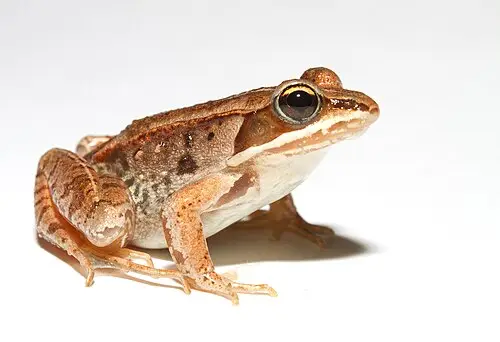
Photo: Brian Gratwicke · CC BY 2.0 · Wikimedia Commons Source
Wood Frog
Rana sylvatica (Wood Frog · Wood Frog)
💡 Everyday Comparisons for Size, Mass & Speed
- 💡 Its average weight of 7.88 g is almost the same as a single Korean 500-won coin (7.7 g) (Comparison).
- 💡 Because frog populations serve as bioindicators of environmental health, declines in their numbers are read as a warning sign, and they also help reduce invertebrate pests (ADW).
Reference standards: coach bus ~12 m, mid-size car ~4.9 m, compact car ~1 t, basketball hoop 3.05 m, credit card 8.56 cm.
Site-computed relative index from recorded values; not a formal scientific metric.
📖 1. Overview
The Wood Frog is a small frog living widely across North America from tundra to forests and wetlands. It is recognized by the dark 'robber's mask' patch running from its eye to its foreleg.
🦴 2. Anatomy & Morphology
Its body length is 3.5–7.6 cm, with females much larger than males. Occurring in several color morphs such as brown, tan, and reddish brown, it is marked by a dark patch extending across the eardrum to the base of the foreleg and a white border along the upper lip.
🔍 3. Ecology & Behavior
Adults eat terrestrial insects, spiders, beetles, slugs, and snails, while tadpoles feed on algae, decaying plant and animal matter, and the eggs of other amphibians. It breeds explosively in early spring from March to May, requiring fish-free seasonal or semi-permanent pools as breeding ponds.
🇰🇷 4. Connection to Korea
No direct record connecting this species to Korea has been found.
📚 Sources & References
- • IUCN Red List LC (2022) — https://www.iucnredlist.org/species/58728/193382501
- • IUCN Red List category LC — latest assessment at iucnredlist.org
- • catalogueoflife.org — V57HH
- • iucnredlist.org — 193382501
- • wikidata.org — Q72725
- • commons.wikimedia.org — File:Lithobates sylvaticus (Woodfrog).jpg
- • animaldiversity.org — Lithobates sylvaticus
- • bok.or.kr — contents.do
- • Silhouette: PhyloPic — Luca Leicht · CC BY 4.0 (Congeneric silhouette — Pelophylax esculentus)
Recorded dimensions are widely cited representative estimates from public literature and may vary by study or specimen.