 📸 Photo
Photo: Pierre Fidenci · CC BY-SA 3.0 · Wikimedia Commons Source
Korean Brown Frog
Rana coreana (Korean Brown Frog · Korean Brown Frog)
💡 Everyday Comparisons for Size, Mass & Speed
- 💡 It can be seen in low wetlands and ponds near rice paddies and farmland across Korea except Jeju Island, and its breeding call continues like a drumbeat, 'keu-keu-keu-keuk' (National List of Species of Korea).
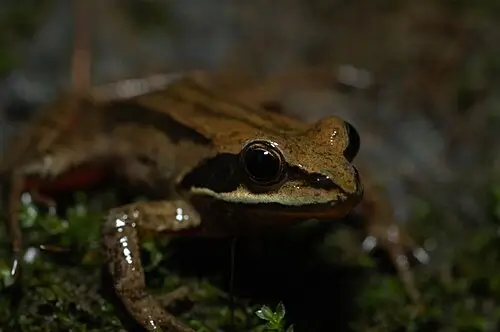
- 💡 By having a black mark in front of the eyes and a white stripe along the upper lip, it is distinguished from Dybowski's Brown Frog and the Huanren Frog, which lack a distinct black mark in front of the eyes and live mainly in high mountain areas (National List of Species of Korea).
Reference standards: coach bus ~12 m, mid-size car ~4.9 m, compact car ~1 t, basketball hoop 3.05 m, credit card 8.56 cm.
📖 1. Overview
The Korean Brown Frog is an endemic species found only in Korea and is the smallest among Korea's brown frogs.
🦴 2. Anatomy & Morphology
Its entire body is dark brown, with a black band running from the front of the snout past the nostrils and eyes to the rear, a thin white stripe along the upper lip, and a pair of thin light-brown dorsolateral ridges on the back. During the breeding season the male's belly is bright white while the female's shows both orange and red.
🔍 3. Ecology & Behavior
It breeds from February to May, laying small egg masses of 400–500 eggs in flooded farmland or pools beside mountain streams. Even after breeding it stays in lowland wetlands rather than moving to mountains or valleys, calling 'keu-keu-keu-keuk' like a drumbeat.
🇰🇷 4. Connection to Korea
An endemic species of Korea, it lives in farmland nationwide except Jeju Island (National List of Species of Korea). It was formerly called 'Rana amurensis coreana.'
📚 Sources & References
- • IUCN Red List LC (2022) — https://www.iucnredlist.org/species/89108544/219751493
- • IUCN Red List category LC — latest assessment at iucnredlist.org
- • catalogueoflife.org — 4RDMF
- • iucnredlist.org — 219751493
- • 국가생물종목록(국립생물자원관) ktsn 120000001389 — https://species.nibr.go.kr/home/mainHome.do?cont_link=009&subMenu=009002&contCd=009002&ktsn=120000001389
- • wikidata.org — Q587360
- • commons.wikimedia.org — File:Rana coreana06.jpeg
- • species.nibr.go.kr — mainHome.do
- • Silhouette: PhyloPic — Luca Leicht · CC BY 4.0 (Congeneric silhouette — Pelophylax esculentus)
Recorded dimensions are widely cited representative estimates from public literature and may vary by study or specimen.