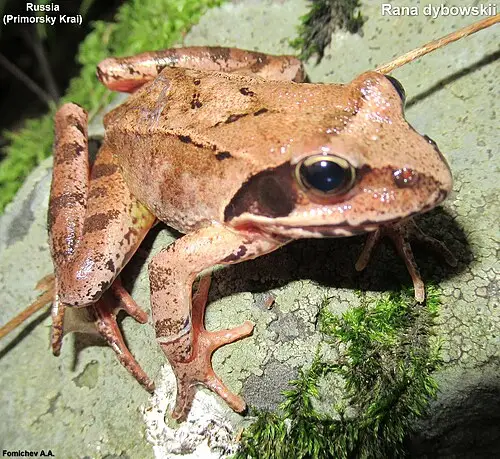
 📸 Photo
Photo: Alexander A. Fomichev · CC BY 4.0 · Wikimedia Commons Source
Dybowski's Brown Frog
Rana dybowskii (Dybowski's Brown Frog · Dybowski's Brown Frog)
💡 Everyday Comparisons for Size, Mass & Speed
- 💡 Its maximum body length of 85 mm is slightly longer than three Korean 500-won coins (26.5 mm in diameter) lined up side by side (79.5 mm) (Comparison).
- 💡 If a 'kkuaak kkuak' sound like a bird call is heard near foothill rice paddies or valley pools in early spring, it may be the breeding call of this frog (National List of Species of Korea).
Reference standards: coach bus ~12 m, mid-size car ~4.9 m, compact car ~1 t, basketball hoop 3.05 m, credit card 8.56 cm.
📖 1. Overview
Dybowski's Brown Frog is a brown frog living in the mountains of Korea as well as in Russia and Tsushima Island, Japan, and is the largest brown frog in Korea. The IUCN assesses it as Near Threatened (NT, 2023).
🦴 2. Anatomy & Morphology
Its body length is 50–85 mm. A distinct black mark extends only behind the eye and is absent in front of the eye, while the belly and throat are milky white. During the breeding season, females turn reddish on the throat and belly, while males have vocal sacs under the chin and develop nuptial pads on the first finger of the forelegs.
🔍 3. Ecology & Behavior
It overwinters under stones in mountain streams and comes down in early spring to pools near rice paddies or streams, where a single female lays an egg mass containing 80–1,000 eggs. During the February–April breeding season it calls 'kkuaak kkuak,' which sounds like a bird call from afar.
🇰🇷 4. Connection to Korea
It lives on Jeju Island and in inland mountain areas nationwide (National List of Species of Korea domestic distribution).
📚 Sources & References
- • IUCN Red List NT (2023) — https://www.iucnredlist.org/species/79128457/79128187
- • IUCN Red List category NT — latest assessment at iucnredlist.org
- • catalogueoflife.org — 4RDP6
- • iucnredlist.org — 79128187
- • 국가생물종목록(국립생물자원관) ktsn 120000001390 — https://species.nibr.go.kr/home/mainHome.do?cont_link=009&subMenu=009002&contCd=009002&ktsn=120000001390
- • wikidata.org — Q3023673
- • commons.wikimedia.org — File:Rana dybowskii 234587552.jpg
- • species.nibr.go.kr — mainHome.do
- • bok.or.kr — contents.do
- • Silhouette: PhyloPic — Luca Leicht · CC BY 4.0 (Congeneric silhouette — Pelophylax esculentus)
Recorded dimensions are widely cited representative estimates from public literature and may vary by study or specimen.