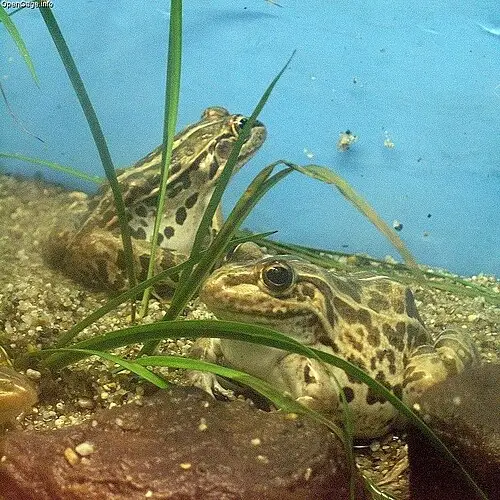
 📸 Photo
Photo: Daiju Azuma · CC BY-SA 2.5 · Wikimedia Commons Source
Black-spotted Pond Frog
Pelophylax nigromaculatus (Black-spotted Pond Frog · トノサマガエル)
💡 Everyday Comparisons for Size, Mass & Speed
- 💡 Its maximum body length of 9 cm is similar to about three and a half Korean 500-won coins (26.5 mm in diameter) lined up side by side (Comparison).
- 💡 Around rice-planting season it lays eggs in rice nurseries and paddies, and males call in chorus with 'kkukkukkuaek, kueek' sounds (National List of Species of Korea). It is a frog that can be met anywhere there are rice paddies and fields.
Reference standards: coach bus ~12 m, mid-size car ~4.9 m, compact car ~1 t, basketball hoop 3.05 m, credit card 8.56 cm.
📖 1. Overview
The Black-spotted Pond Frog is a frog living near rice paddies and ponds in East Asia, including Korea, China, and Japan, and is also called the paddy frog. Its 3 longitudinal lines down the back are distinctive.
🦴 2. Anatomy & Morphology
Its body length is 6–9 cm. On its back, it has 1 median line running from the tip of the snout to the vent and 2 long dorsolateral ridges starting behind the eyes. Males have yellow or green stripes on a gold or green background on the back, while females have black spots scattered on a white background.
🔍 3. Ecology & Behavior
From April to June it lays non-adhesive egg masses of about 2,000–3,000 eggs each in rice nurseries, paddies, and ponds, which hatch after a week. It spends the winter in moist soil of rice paddies and fields, and tadpoles grow up to 70 mm before coming onto land from July to September.
🇰🇷 4. Connection to Korea
It lives around agricultural land throughout Korea (National List of Species of Korea domestic distribution: nationwide).
📚 Sources & References
- • IUCN Red List LC (2023) — https://www.iucnredlist.org/species/58679/63862076
- • IUCN Red List category LC — latest assessment at iucnredlist.org
- • catalogueoflife.org — 76CHL
- • iucnredlist.org — 63862076
- • 국가생물종목록(국립생물자원관) ktsn 120000164708 — https://species.nibr.go.kr/home/mainHome.do?cont_link=009&subMenu=009002&contCd=009002&ktsn=120000164708
- • wikidata.org — Q1072424
- • commons.wikimedia.org — File:Rana nigromaculata.jpg
- • species.nibr.go.kr — mainHome.do
- • bok.or.kr — contents.do
- • Silhouette: PhyloPic — Luca Leicht · CC BY 4.0 (Congeneric silhouette — Pelophylax)
Recorded dimensions are widely cited representative estimates from public literature and may vary by study or specimen.