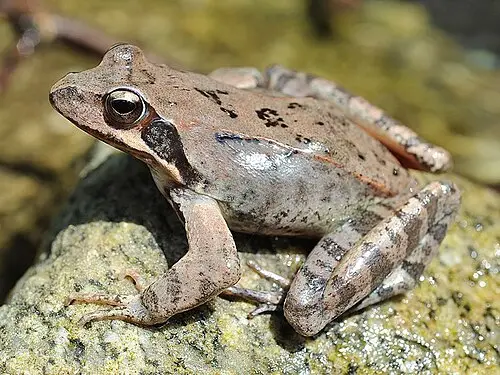
 📸 Photo
Photo: Kim, Hyun-tae · CC BY 4.0 · Wikimedia Commons Source
Ueno's Brown Frog
Rana uenoi (Ueno's Brown Frog · チョウセンヤマアカガエル)
💡 Everyday Comparisons for Size, Mass & Speed
- 💡 The female maximum length of 84 mm is slightly longer than three Korean 500-won coins (26.5 mm in diameter) lined up side by side (79.5 mm) (Comparison).
- 💡 It is most frequently observed in early spring (February–March) around foothill paddy pools and valley streams, where round egg masses can be seen sunken underwater or floating at the surface (National List of Species of Korea).
Reference standards: coach bus ~12 m, mid-size car ~4.9 m, compact car ~1 t, basketball hoop 3.05 m, credit card 8.56 cm.
📖 1. Overview
Ueno's Brown Frog is a medium-sized brown frog living across Korea and on Tsushima Island in Japan, and has the largest body among Korea's 3 brown frog species. Described as a new species in 2014, it was formerly listed as Rana dybowskii on the Japanese Red List.
🦴 2. Anatomy & Morphology
Adult body length is 4–7 cm in Korean sources, while Japanese sources give 52–64 mm for males and 58–84 mm for females, making females larger. Males have a pair of vocal sacs behind both eardrums, a dark-brown triangular patch over the eardrum area, and 2 thin, long dorsolateral ridges on the back.
🔍 3. Ecology & Behavior
Emerging from hibernation from February to April to breed in groups, it lays ball-shaped egg masses of 400–1,200 eggs in valley pools, rice paddies, and wetlands. From May to October it moves into forests to prey on beetles, true bugs, caterpillars, spiders, and earthworms, and from November it overwinters under submerged stones in valley streams.
🇰🇷 4. Connection to Korea
Distributed nationwide including Jeju Island, it has been observed at 5,228 sites. It is most frequently seen in forests (49.1%) and farmland (29.0%), appearing most often in February and March (National List of Species of Korea). In Japan it occurs only on Tsushima Island and is listed as Endangered IB (EN) on the Ministry of the Environment Red List.
📚 Sources & References
- • IUCN Red List LC (2023) — https://www.iucnredlist.org/species/79128172/110102106
- • IUCN Red List category LC — latest assessment at iucnredlist.org
- • catalogueoflife.org — 6X38Z
- • iucnredlist.org — 110102106
- • 국가생물종목록(국립생물자원관) ktsn 120000474040 — https://species.nibr.go.kr/home/mainHome.do?cont_link=009&subMenu=009002&contCd=009002&ktsn=120000474040
- • wikidata.org — Q18123765
- • commons.wikimedia.org — File:Rana uenoi.jpg
- • env.go.jp — AM0037 RDB5th.pdf
- • species.nibr.go.kr — mainHome.do
- • bok.or.kr — contents.do
- • Silhouette: PhyloPic — Luca Leicht · CC BY 4.0 (Congeneric silhouette — Pelophylax esculentus)
Recorded dimensions are widely cited representative estimates from public literature and may vary by study or specimen.