 📸 Photo
Photo: Brian Gratwicke · CC BY 2.0 · Wikimedia Commons Source
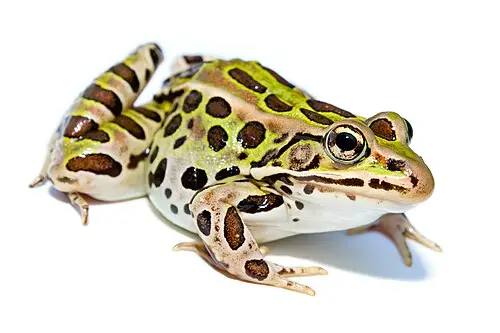
Northern Leopard Frog
Rana pipiens (Northern Leopard Frog · Northern Leopard Frog)
💡 Everyday Comparisons for Size, Mass & Speed
- 💡 Its average weight of about 29 g is roughly that of four Korean 500-won coins (7.7 g), and its maximum length of 11.1 cm is slightly longer than four Korean 500-won coins lined up side by side (106 mm) (Comparison).
- 💡 It is eaten as frog legs and is also widely used in biological and medical research as well as school biology dissection classes (ADW).
Reference standards: coach bus ~12 m, mid-size car ~4.9 m, compact car ~1 t, basketball hoop 3.05 m, credit card 8.56 cm.
Site-computed relative index from recorded values; not a formal scientific metric.
📖 1. Overview
The Northern Leopard Frog is a leopard-spotted frog living widely across North America from marshes, brushlands, and forests to farmland and golf courses. Cold-hardy, it occurs up to 3,350 m above sea level.
🦴 2. Anatomy & Morphology
Its body length is 5–11.1 cm, with females larger than males. Its green to greenish-brown back bears round brown spots rimmed in white or yellow, with distinct white dorsolateral folds extending back from the eyes, while males have thick thumb pads and a pair of vocal sacs on the neck.
🔍 3. Ecology & Behavior
After metamorphosis it eats spiders, insects, slugs, snails, and earthworms, and large individuals also catch small frogs. From March to June (peaking in April), it lays masses of 300–6,500 eggs in breeding ponds.
🇰🇷 4. Connection to Korea
No direct record connecting this species to Korea has been found.
📚 Sources & References
- • IUCN Red List LC (2022) — https://www.iucnredlist.org/species/79079800/3072377
- • IUCN Red List category LC — latest assessment at iucnredlist.org
- • catalogueoflife.org — 3VHQP
- • iucnredlist.org — 3072377
- • wikidata.org — Q26830590
- • commons.wikimedia.org — File:Lithobates pipiens.jpg
- • animaldiversity.org — Lithobates pipiens
- • bok.or.kr — contents.do
- • Silhouette: PhyloPic — Luca Leicht · CC BY 4.0 (Congeneric silhouette — Pelophylax esculentus)
Recorded dimensions are widely cited representative estimates from public literature and may vary by study or specimen.