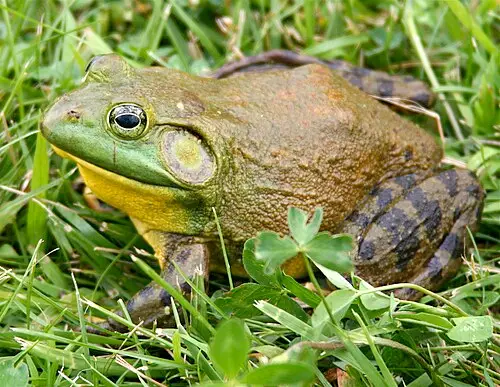
 📸 Photo
Photo: Carl D. Howe · CC BY-SA 2.5 · Wikimedia Commons Source
American Bullfrog
Rana catesbeiana (American Bullfrog · ウシガエル)
💡 Everyday Comparisons for Size, Mass & Speed
- 💡 Its maximum length of 203 mm is about seven and a half Korean 500-won coins (26.5 mm in diameter) lined up side by side, and its maximum weight of 0.5 kg equals about 65 Korean 500-won coins (7.7 g) (Comparison).
- 💡 In North America its hind legs are harvested as frog legs during regulated hunting seasons (ADW), and in Korea it was imported and farmed for food in the 1960–70s (National List of Species of Korea).
Reference standards: coach bus ~12 m, mid-size car ~4.9 m, compact car ~1 t, basketball hoop 3.05 m, credit card 8.56 cm.
Site-computed relative index from recorded values; not a formal scientific metric.
📖 1. Overview
The American Bullfrog is a large frog native to North America and the largest true frog on that continent. Introduced to Korea in the 1960–70s for food, it has become an invasive species that disrupts local ecosystems.
🦴 2. Anatomy & Morphology
Weighing up to 0.5 kg and usually measuring 9–15 cm in length, it has well-developed webbing on its hind feet. Males have eardrums much larger than their eyes and develop yellow throats during the breeding season, and their low, booming calls carry more than 1 km.
🔍 3. Ecology & Behavior
An ambush predator that waits motionless at the water's edge before shooting out its tongue like lightning, it eats snakes, insects, crustaceans, and frogs as well as small birds and mice. Females lay up to 20,000 eggs at a time, and tadpoles spend 1–3 years in the water before becoming frogs.
🇰🇷 4. Connection to Korea
Brought into Korea in the 1960–70s to be raised for food, it escaped during monsoon floods and spread through rivers and waterways nationwide as an ecologically harmful alien species (National List of Species of Korea). On February 19, 1998, it was designated an Ecosystem-disturbing Species (Paju-si environmental guide).
📚 Sources & References
- • IUCN Red List LC (2022) — https://www.iucnredlist.org/species/58565/193396825
- • IUCN Red List category LC — latest assessment at iucnredlist.org
- • catalogueoflife.org — LN27W
- • iucnredlist.org — 193396825
- • wikidata.org — Q159404
- • commons.wikimedia.org — File:North-American-bullfrog1.jpg
- • animaldiversity.org — Lithobates catesbeianus
- • species.nibr.go.kr — mainHome.do
- • paju.go.kr — environment 01 03 05.jsp
- • bok.or.kr — contents.do
- • Silhouette: PhyloPic — Chuanixn Yu · CC0 1.0
Recorded dimensions are widely cited representative estimates from public literature and may vary by study or specimen.