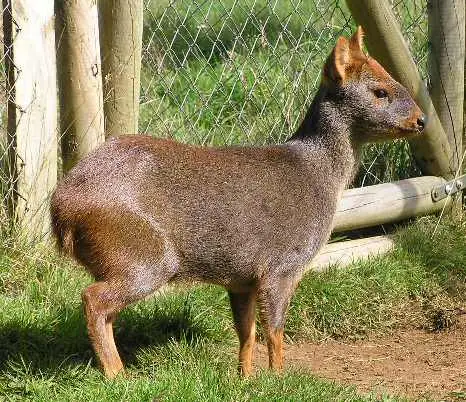
 📸 Photo
Photo: Jaime E. Jimenez · CC BY-SA 3.0 · Wikimedia Commons Source
Southern Pudu
Pudu puda (Southern Pudu · プーズー)
💡 Everyday Comparisons for Size, Mass & Speed
- 💡 Its shoulder height of 35–45 cm is just slightly taller than the long side of an A4 sheet of paper (about 30 cm) (Comparison).
- 💡 It is kept in zoos and the pet trade in South America, North America, and Europe, and has also been hunted for meat and fur (Animal Diversity Web).
- 💡 Its maximum weight of 15 kg equals 3/4 of a 20 kg bag of rice (Comparison).
Reference standards: coach bus ~12 m, mid-size car ~4.9 m, compact car ~1 t, basketball hoop 3.05 m, credit card 8.56 cm.
Site-computed relative index from recorded values; not a formal scientific metric.
📖 1. Overview
The Southern Pudu is the second smallest deer in the world and lives hidden in the low undergrowth of South American forests.
🦴 2. Anatomy & Morphology
Measuring 35–45 cm at the shoulder, its small body has short legs and a rump that is not raised. Between its hooves lies a scent gland enclosed in a deep pocket.
🔍 3. Ecology & Behavior
It is a ruminant that selectively browses on ferns, tree leaves, vines, and herbs along forest edges or clearings. Active both day and night, it shows playful behavior such as skipping and running, and it does not tolerate heat well.
🇰🇷 4. Connection to Korea
No direct record connecting this species to Korea has been found.
📚 Sources & References
- • IUCN Red List NT (2016) — https://www.iucnredlist.org/species/18848/22164089
- • IUCN Red List category NT — latest assessment at iucnredlist.org
- • mammaldiversity.org — 1006305
- • iucnredlist.org — 22164089
- • wikidata.org — Q927065
- • commons.wikimedia.org — File:Pudupuda hem 8 FdoVidal Villarr 08Abr06-PhotoJimenez.JP
- • animaldiversity.org — Pudu puda
- • Silhouette: PhyloPic — An Ignorant Atheist · CC0 1.0 (Related taxon silhouette — Cervidae)
Recorded dimensions are widely cited representative estimates from public literature and may vary by study or specimen.