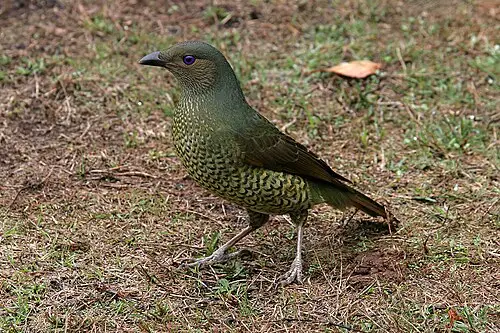
 📸 Photo
Photo: John Manger, CSIRO · CC BY 3.0 · Wikimedia Commons Source
Satin Bowerbird
Ptilonorhynchus violaceus (Satin Bowerbird · アオアズマヤドリ)
💡 Everyday Comparisons for Size, Mass & Speed
- 💡 Males love to steal human-made blue objects such as clothespins, drinking straws, and bottle caps to decorate their bowers (Australian Museum).
- 💡 Its body length of 33 cm is slightly longer than a 30 cm ruler (Comparison).
- 💡 In winter, it moves into open areas and sometimes enters orchards (Australian Museum).
Reference standards: coach bus ~12 m, mid-size car ~4.9 m, compact car ~1 t, basketball hoop 3.05 m, credit card 8.56 cm.
📖 1. Overview
The Satin Bowerbird is a medium-sized bird living along the eastern and southeastern coast of Australia, famous for males building courtship 'bowers' of twigs and decorating them with blue objects.
🦴 2. Anatomy & Morphology
Adult males have glossy blue-black satin plumage, a bluish-white bill, and violet-blue eyes. Young males and females have olive upperparts with scaly underparts and are called 'green birds'; males do not acquire full adult plumage until about 7 years of age.
🔍 3. Ecology & Behavior
It feeds mainly on fruit all year round, taking insects during the summer breeding season and leaves in winter. Males build a two-walled avenue bower of twigs on the ground, decorate it with blue objects, and dance before females, while the female builds the nest alone and incubates 2–3 eggs for about 21 days.
🇰🇷 4. Connection to Korea
No direct record connecting this species to Korea has been found.
📚 Sources & References
- • IUCN Red List LC (2018) — https://www.iucnredlist.org/species/22703679/130219832
- • IUCN Red List category LC — latest assessment at iucnredlist.org
- • doi.org — avilist.v2026
- • iucnredlist.org — 130219832
- • wikidata.org — Q585670
- • commons.wikimedia.org — File:CSIRO ScienceImage 3574 Satin Bowerbird.jpg
- • australian.museum — satin-bowerbird
- • Silhouette: PhyloPic — Ferran Sayol · CC0 1.0 (Related taxon silhouette — Sericulus)
Recorded dimensions are widely cited representative estimates from public literature and may vary by study or specimen.