 📸 Photo
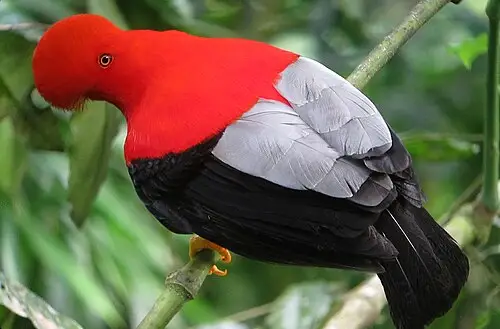
Photo: Félix Uribe from Rionegro, Antioquia, Colombia · CC BY-SA 2.0 · Wikimedia Commons Source
Andean Cock-of-the-rock
Rupicola peruvianus (Andean Cock-of-the-rock · アンデスイワドリ)
💡 Everyday Comparisons for Size, Mass & Speed
- 💡 Its body length of 34 cm is slightly longer than a 30 cm ruler (Comparison).
- 💡 In the early morning and at dusk, males gather at a single spot to hold a 'lek,' grunting and dancing together (Birds of the World).
Reference standards: coach bus ~12 m, mid-size car ~4.9 m, compact car ~1 t, basketball hoop 3.05 m, credit card 8.56 cm.
📖 1. Overview
The Andean Cock-of-the-rock is a fairly large bird living in humid forests on Andean slopes from western Venezuela to northern Bolivia, famous for the male's vivid orange plumage.
🦴 2. Anatomy & Morphology
Males have an orange to reddish-orange body with black wings and tail, and a flattened, puffed crest that covers the yellow bill. Females are reddish-brown to cinnamon with a smaller crest.
🔍 3. Ecology & Behavior
It feeds mainly on fruits from more than 50 plant species and occasionally eats large insects and small vertebrates such as frogs and lizards. Males dance to court females at fixed display sites (leks) in the forest, while the female builds the nest alone and incubates 2 eggs for 26–28 days.
🇰🇷 4. Connection to Korea
No direct record connecting this species to Korea has been found.
📚 Sources & References
- • IUCN Red List LC (2018) — https://www.iucnredlist.org/species/22700974/130267257
- • IUCN Red List category LC — latest assessment at iucnredlist.org
- • doi.org — avilist.v2026
- • iucnredlist.org — 130267257
- • wikidata.org — Q490393
- • commons.wikimedia.org — File:Rupicola peruvianus Gallito de roca andino Andean-Cock-
- • neotropical.birds.cornell.edu — overview
- • Silhouette: PhyloPic — Gargominy O. · CC BY 4.0 (Congeneric silhouette — Neostyriaca corynodes)
Recorded dimensions are widely cited representative estimates from public literature and may vary by study or specimen.