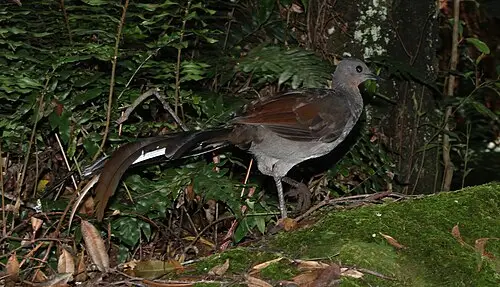
 📸 Photo
Photo: Greg Tasney · CC BY-SA 4.0 · Wikimedia Commons Source
Superb Lyrebird
Menura novaehollandiae (Superb Lyrebird · コトドリ)
💡 Everyday Comparisons for Size, Mass & Speed
- 💡 It is famous for being able to mimic almost any sound (New South Wales Government).
- 💡 Its length of 1 m including the tail is similar to the height of a lower-grade elementary school child.
- 💡 Its average weight of 975 g is slightly lighter than a 1 L carton of milk (about 1 kg).
Reference standards: coach bus ~12 m, mid-size car ~4.9 m, compact car ~1 t, basketball hoop 3.05 m, credit card 8.56 cm.
Site-computed relative index from recorded values; not a formal scientific metric.
📖 1. Overview
The Superb Lyrebird is a large ground-dwelling bird native to southeastern Australia whose male spreads a lyre-shaped tail in courtship and mimics almost any sound.
🦴 2. Anatomy & Morphology
Its upperparts are dark brown and its underparts are paler brown with reddish-brown markings on the throat. Its strong legs and long toes and claws are suited for raking leaf litter, while its short, rounded wings are rarely used for flight.
🔍 3. Ecology & Behavior
It scratches through leaf litter to find small soil invertebrates such as insects, spiders, and frogs. Courtship takes place from May to August, and the female builds the nest alone, lays a single egg, and incubates it for about 6 weeks.
🇰🇷 4. Connection to Korea
No direct record connecting this species to Korea has been found.
📚 Sources & References
- • IUCN Red List LC (2018) — https://www.iucnredlist.org/species/22703605/132071218
- • IUCN Red List category LC — latest assessment at iucnredlist.org
- • doi.org — avilist.v2026
- • iucnredlist.org — 132071218
- • wikidata.org — Q757013
- • environment.nsw.gov.au — lyrebirds
- • birdsinbackyards.net — Menura-novaehollandiae
- • Silhouette: PhyloPic — Anders Alexander · CC0 1.0
Recorded dimensions are widely cited representative estimates from public literature and may vary by study or specimen.