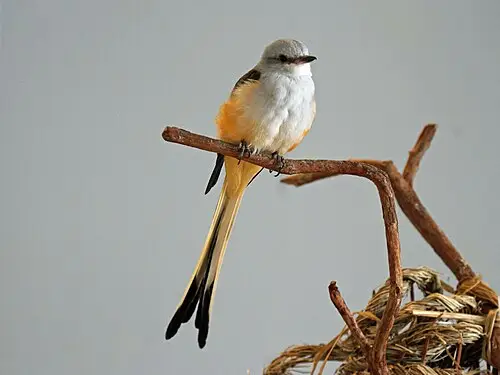
 📸 Photo
Photo: DickDaniels ( http://theworldbirds.org/ ) · CC BY-SA 4.0 · Wikimedia Commons Source
Scissor-tailed Flycatcher
Tyrannus forficatus (Scissor-tailed Flycatcher · エンビタイランチョウ)
💡 Everyday Comparisons for Size, Mass & Speed
- 💡 Its body length of 22.5 cm is slightly longer than the short side of an A4 sheet of paper (21 cm) (Comparison).
- 💡 Its weight of 43 g is about the weight of 5.6 Korean 500-won coins (7.7 g each) (Comparison).
- 💡 Because a large portion of its diet consists of crop pests, it helps ecosystems around farmlands (ADW).
Reference standards: coach bus ~12 m, mid-size car ~4.9 m, compact car ~1 t, basketball hoop 3.05 m, credit card 8.56 cm.
Site-computed relative index from recorded values; not a formal scientific metric.
📖 1. Overview
The Scissor-tailed Flycatcher is a bird that breeds in open country of south-central North America and migrates south for the winter, famous for its long, scissor-like forked tail.
🦴 2. Anatomy & Morphology
It has a slender pale gray and black body with a white tail, pink flanks, and red patches at the shoulders under the wings. A gap between its long tail feathers makes them look like scissors, and females are usually smaller than males with shorter tails.
🔍 3. Ecology & Behavior
It feeds mainly on grasshoppers and beetles and also eats bees, wasps, spiders, crickets, and fruits. It snatches insects in flight or gleans them from leaves, laying 4–5 eggs per clutch and incubating them for 12–14 days.
🇰🇷 4. Connection to Korea
No direct record connecting this species to Korea has been found.
📚 Sources & References
- • IUCN Red List LC (2021) — https://www.iucnredlist.org/species/22700500/137915793
- • IUCN Red List category LC — latest assessment at iucnredlist.org
- • doi.org — avilist.v2026
- • iucnredlist.org — 137915793
- • wikidata.org — Q1189983
- • commons.wikimedia.org — File:Scissor-tailed Flycatcher RWD7.jpg
- • animaldiversity.org — Tyrannus forficatus
- • Silhouette: PhyloPic — author not recorded · CC0 1.0
Recorded dimensions are widely cited representative estimates from public literature and may vary by study or specimen.