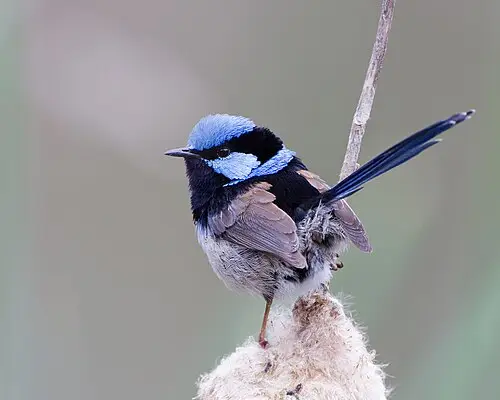
 📸 Photo
Photo: JJ Harrison ( https://www.jjharrison.com.au/ ) · CC BY-SA 3.0 · Wikimedia Commons Source
Superb Fairywren
Malurus cyaneus (Superb Fairywren · ルリオーストラリアムシクイ)
💡 Everyday Comparisons for Size, Mass & Speed
- 💡 Having adapted to urban parks, gardens, and thickets of introduced weeds, it is easily seen close to people (Australian Museum).
- 💡 Because a female may be courted by up to 13 males within 30 minutes and 76% of young are sired by males outside the social group, it has earned the nickname 'the least faithful bird in the world' (Australian Museum).
Reference standards: coach bus ~12 m, mid-size car ~4.9 m, compact car ~1 t, basketball hoop 3.05 m, credit card 8.56 cm.
📖 1. Overview
The Superb Fairywren is a small bird native to southeastern Australia, notable for the breeding male's bright blue crown and cheeks and for raising its young cooperatively as a family.
🦴 2. Anatomy & Morphology
Breeding males have a sky-blue crown and cheeks, a black eye-stripe, a dark blue-black throat, brown wings, and a white belly. Females are mostly brown with a white throat and belly and an orange-red bill, while non-breeding males resemble females except for a black bill and a dark navy tail.
🔍 3. Ecology & Behavior
It forages mainly on the ground for insects such as grasshoppers, ants, and caterpillars, as well as small seeds and berries. A breeding pair and up to 7 helpers raise the young cooperatively, and the female lays 3–4 eggs in a domed nest woven with spiderwebs.
🇰🇷 4. Connection to Korea
No direct record connecting this species to Korea has been found.
📚 Sources & References
- • IUCN Red List LC (2024) — https://www.iucnredlist.org/species/22703736/253995896
- • IUCN Red List category LC — latest assessment at iucnredlist.org
- • doi.org — avilist.v2026
- • iucnredlist.org — 253995896
- • wikidata.org — Q420813
- • commons.wikimedia.org — File:Malurus cyaneus PM.jpg
- • australian.museum — superb-fairy-wren
- • Silhouette: PhyloPic — Michael Scroggie · CC0 1.0
Recorded dimensions are widely cited representative estimates from public literature and may vary by study or specimen.