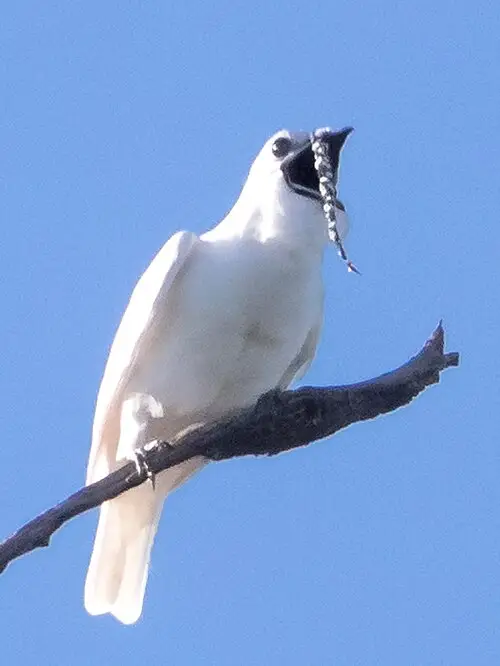
 📸 Photo
Photo: Hector Bottai from São Paulo, Brasil · CC BY-SA 2.0 · Wikimedia Commons Source
White Bellbird
Procnias albus (White Bellbird · スズドリ)
💡 Everyday Comparisons for Size, Mass & Speed
- 💡 The word 'bell' in its name comes from its clear bell-like call, which is considered the most bell-like among the 4 species of Procnias (Birds of the World).
- 💡 Rarely recorded even on the island of Trinidad, it is known as a bird that wanders far from its breeding range (Birds of the World).
Reference standards: coach bus ~12 m, mid-size car ~4.9 m, compact car ~1 t, basketball hoop 3.05 m, credit card 8.56 cm.
📖 1. Overview
The White Bellbird is said to have the most bell-like call among the 4 species in the genus Procnias, living in tall forests of the Guianan Highlands.
🦴 2. Anatomy & Morphology
True to its name, the male is completely white and has a black whisker-like fleshy wattle hanging over the bill adorned with white rosette-like tufts. Females are mainly green and yellow.
🔍 3. Ecology & Behavior
Recorded sporadically in central Amazonia and on Trinidad, it appears to be a seasonal migrant or at least a long-distance wanderer. It is considered most closely related to Central America's Three-wattled Bellbird (Procnias tricarunculatus).
🇰🇷 4. Connection to Korea
No direct record connecting this species to Korea has been found.
📚 Sources & References
- • IUCN Red List LC (2024) — https://www.iucnredlist.org/species/22700957/264389139
- • IUCN Red List category LC — latest assessment at iucnredlist.org
- • doi.org — avilist.v2026
- • iucnredlist.org — 264389139
- • wikidata.org — Q592571
- • commons.wikimedia.org — File:White Bellbird-Araponga-da-amazônia-Campanero blanco (P
- • neotropical.birds.cornell.edu — overview
- • Silhouette: PhyloPic — Edwin Price · CC BY 4.0 (Congeneric silhouette — Procnias tricarunculatus)
Recorded dimensions are widely cited representative estimates from public literature and may vary by study or specimen.