 📸 Photo
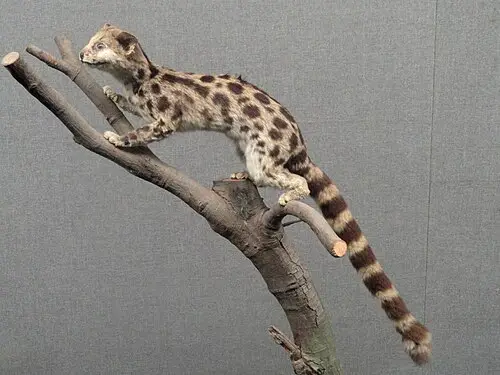
Photo: Daderot · Public domain · Wikimedia Commons Source
Spotted Linsang
Prionodon pardicolor (Spotted Linsang · ブチリンサン)
💡 Everyday Comparisons for Size, Mass & Speed
- 💡 Its 41 cm length from nose tip to tail base is about 1.4 times the long side of an A4 sheet of paper (29.7 cm) (Comparison).
- 💡 Its average weight of 595 g is slightly heavier than a 500 mL bottle of water (Comparison).
- 💡 Unlike civets, it lacks scent glands used for perfume and is not exploited for civet musk (Animal Diversity Web).
Reference standards: coach bus ~12 m, mid-size car ~4.9 m, compact car ~1 t, basketball hoop 3.05 m, credit card 8.56 cm.
Site-computed relative index from recorded values; not a formal scientific metric.
📖 1. Overview
The Spotted Linsang is a long, slender arboreal predator that lives in the tropical forests of mainland Southeast Asia. Because of its shy and reclusive nature, very little is known about it in the wild.
🦴 2. Anatomy & Morphology
It has a fox-like head with a longer muzzle, large dark eyes that see well at night, and mobile pointed ears. Its fur is velvety soft and dense with spots arranged in lengthwise rows, and its long, fluffy tail has 8–10 dark rings.
🔍 3. Ecology & Behavior
It mainly hunts rodents and also eats birds, insects, small reptiles, frogs, eggs, carrion, and fruit. Active at night, it sleeps during the day in nests in tree hollows or under roots. Breeding seasons occur in February and August, and litters of 2 are common.
🇰🇷 4. Connection to Korea
No direct record connecting this species to Korea has been found.
📚 Sources & References
- • IUCN Red List LC (2024) — https://www.iucnredlist.org/species/41706/259356428
- • IUCN Red List category LC — latest assessment at iucnredlist.org
- • mammaldiversity.org — 1006026
- • iucnredlist.org — 259356428
- • wikidata.org — Q1344102
- • commons.wikimedia.org — File:Prionodon pardicolor - Kunming Natural History Museum o
- • animaldiversity.org — Prionodon pardicolor
- • Silhouette: PhyloPic — Margot Michaud · CC0 1.0
Recorded dimensions are widely cited representative estimates from public literature and may vary by study or specimen.