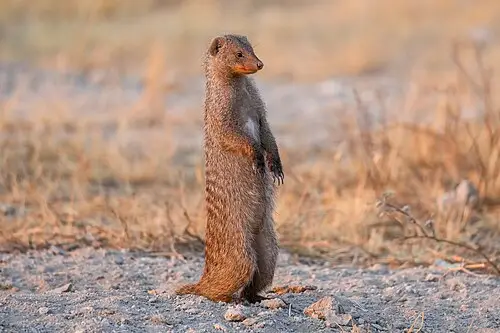
 📸 Photo
Photo: Giles Laurent · CC BY-SA 4.0 · Wikimedia Commons Source
Banded Mongoose
Mungos mungo (Banded Mongoose · シママングース)
💡 Everyday Comparisons for Size, Mass & Speed
- 💡 A total length of 60 cm is about twice the long side of an A4 sheet of paper (29.7 cm) (Comparison).
- 💡 A weight of 1.5 kg is about three-quarters of a 2-liter bottle of water (Comparison).
- 💡 It may travel more than 5 miles (about 8 km) a day in search of food, and becomes a tame pet when hand-raised from a young age (Smithsonian, ADW).
Reference standards: coach bus ~12 m, mid-size car ~4.9 m, compact car ~1 t, basketball hoop 3.05 m, credit card 8.56 cm.
Site-computed relative index from recorded values; not a formal scientific metric.
📖 1. Overview
The Banded Mongoose lives across sub-Saharan Africa from the Gambia to northeastern Ethiopia and South Africa, and is active by day in packs of 10–20. Even when the pack stays together, individuals forage on their own.
🦴 2. Anatomy & Morphology
Dark bands run across the back from the mid-back to the base of the tail, and the feet and tail tip are dark. The front feet have 5 digits with long, curved claws for scratching and digging, and the tail is about half the head-body length.
🔍 3. Ecology & Behavior
It feeds mainly on insects and smashes hard prey such as snails or eggs by throwing them backward between its hind legs against a stone. It also eats lizards, snakes, rodents, bird eggs, and fruit. After a gestation of about 2 months, it gives birth to 2–6 young in a grass-lined burrow.
🇰🇷 4. Connection to Korea
No direct record connecting this species to Korea has been found.
📚 Sources & References
- • IUCN Red List LC (2016) — https://www.iucnredlist.org/species/41621/45208886
- • IUCN Red List category LC — latest assessment at iucnredlist.org
- • mammaldiversity.org — 1006069
- • iucnredlist.org — 45208886
- • wikidata.org — Q23121
- • commons.wikimedia.org — File:171 Banded mongoose standing at sunset in Etosha Nation
- • animaldiversity.org — Mungos mungo
- • nationalzoo.si.edu — banded-mongoose
- • Silhouette: PhyloPic — Margot Michaud · CC0 1.0
Recorded dimensions are widely cited representative estimates from public literature and may vary by study or specimen.