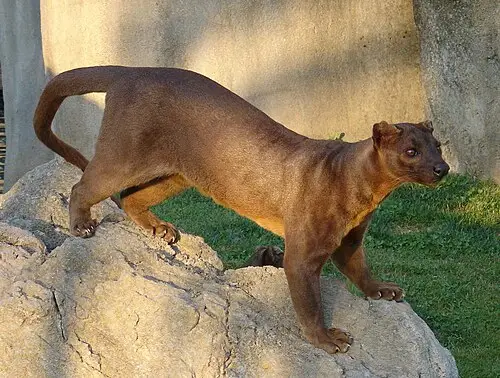
 📸 Photo
Photo: Ran Kirlian · CC BY-SA 4.0 · Wikimedia Commons Source
Fossa
Cryptoprocta ferox (Fossa · フォッサ)
💡 Everyday Comparisons for Size, Mass & Speed
- 💡 A body length of 80 cm is about 2.7 times the long side of A4 paper (29.7 cm) (Comparison).
- 💡 A weight of 12 kg is slightly heavier than a 10 kg bag of rice (Comparison).
- 💡 It is a popular animal for ecotourism in Madagascar (ADW).
Reference standards: coach bus ~12 m, mid-size car ~4.9 m, compact car ~1 t, basketball hoop 3.05 m, credit card 8.56 cm.
Site-computed relative index from recorded values; not a formal scientific metric.
📖 1. Overview
The Fossa is a cat-like carnivore found only on the island of Madagascar and is the largest mammalian carnivore on the island. It lives in forests with plenty of cover.
🦴 2. Anatomy & Morphology
It has a cat-like blunt nose, large forward-facing eyes, whiskers as long as its head, and short, thick reddish-brown fur (rarely black individuals). Its claws are short, curved, and retractable, and its tail is as long as its body.
🔍 3. Ecology & Behavior
It eats small mammals, birds, reptiles, amphibians, and insects, and even chases lemurs through the trees. Solitary and active mainly at night or at dawn and dusk, it holds a territory of about 1 km². Mating takes place in September–October, and after about 3 months of gestation, 2–4 young are born in a den in December–January.
🇰🇷 4. Connection to Korea
No direct record connecting this species to Korea has been found.
📚 Sources & References
- • IUCN Red List VU (2016) — https://www.iucnredlist.org/species/5760/45197189
- • IUCN Red List category VU — latest assessment at iucnredlist.org
- • mammaldiversity.org — 1006028
- • iucnredlist.org — 45197189
- • wikidata.org — Q183330
- • commons.wikimedia.org — File:Cryptoprocta Ferox.JPG
- • animaldiversity.org — Cryptoprocta ferox
- • Silhouette: PhyloPic — Margot Michaud · CC0 1.0
Recorded dimensions are widely cited representative estimates from public literature and may vary by study or specimen.