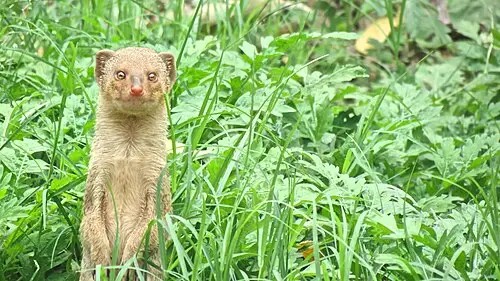
 📸 Photo
Photo: Minakksi · CC BY-SA 4.0 · Wikimedia Commons Source
Small Indian Mongoose
Urva auropunctata (Small Indian Mongoose · フイリマングース)
💡 Everyday Comparisons for Size, Mass & Speed
- 💡 A male's maximum head-body length of 67.1 cm is about 2.3 times the long side of a sheet of A4 paper (29.7 cm) (Comparison).
- 💡 A male's average weight of 650 g is similar to one and a half 500 mL bottles of water (Comparison).
- 💡 Introduced from the 1870s to control rats in West Indian sugarcane plantations and brought to Hawaii in 1883, it reduced rat numbers only slightly while severely harming native wildlife, making it one of the most failed biological control efforts. It also harms endangered species such as the Amami Rabbit (ADW; IUCN Global Invasive Species Database).
Reference standards: coach bus ~12 m, mid-size car ~4.9 m, compact car ~1 t, basketball hoop 3.05 m, credit card 8.56 cm.
Site-computed relative index from recorded values; not a formal scientific metric.
📖 1. Overview
The Small Indian Mongoose is a small mongoose native from Pakistan to Southeast Asia that was introduced to the West Indies, Hawaii, and elsewhere to control rats and snakes. It is notorious for harming native wildlife wherever it was introduced.
🦴 2. Anatomy & Morphology
It has a slender body, short legs, an elongated head, and a pointed snout. Its soft fur ranges from pale to dark brown flecked with golden spots, with a paler belly, and males have broader heads and sturdier bodies.
🔍 3. Ecology & Behavior
Although it mainly eats insects, it is an opportunistic omnivore that also takes birds, eggs, reptiles, amphibians, rats, and fruits whenever available. It breeds two or three times a year and gives birth to about 3 young per litter.
🇰🇷 4. Connection to Korea
No direct record connecting this species to Korea has been found.
📚 Sources & References
- • IUCN Red List LC (2016) — https://www.iucnredlist.org/species/70204120/70204139
- • IUCN Red List category LC — latest assessment at iucnredlist.org
- • mammaldiversity.org — 1006050
- • iucnredlist.org — 70204139
- • wikidata.org — Q123900653
- • commons.wikimedia.org — File:Astonished.jpg
- • iucngisd.org — species.php
- • animaldiversity.org — Herpestes javanicus
- • Silhouette: PhyloPic — Margot Michaud · CC0 1.0
Recorded dimensions are widely cited representative estimates from public literature and may vary by study or specimen.