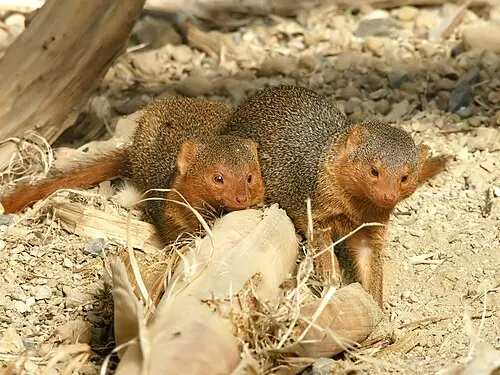
 📸 Photo
Photo: Hans Hillewaert · CC BY-SA 3.0 · Wikimedia Commons Source
Common Dwarf Mongoose
Helogale parvula (Common Dwarf Mongoose · コビトマングース)
💡 Everyday Comparisons for Size, Mass & Speed
- 💡 Its head-and-body length of 26 cm is about 1.5 times the length of a new pencil (about 17.5 cm) (Comparison).
- 💡 Its average weight of 275 g is slightly heavier than one 250 mL drink can (Comparison).
- 💡 It lives in an extended family society with a 'babysitting' system in which younger members take turns caring for the pups (ADW).
Reference standards: coach bus ~12 m, mid-size car ~4.9 m, compact car ~1 t, basketball hoop 3.05 m, credit card 8.56 cm.
Site-computed relative index from recorded values; not a formal scientific metric.
📖 1. Overview
The Common Dwarf Mongoose is a tiny mongoose living in African savannas and scrublands, where an older dominant female and her matriline form a pack occupying a home range of about 2 ha.
🦴 2. Anatomy & Morphology
Small in build, it measures 18–26 cm in head-and-body length with a 12–20 cm tail. Its speckled brown-to-gray coat is darker on the tail and lower legs and slightly paler on the belly.
🔍 3. Ecology & Behavior
It spends most of the day searching for insects among brush, leaf litter, and rocks, and occasionally eats small vertebrates, eggs, and fruit. Only the dominant pair breeds, while subadults take turns 'babysitting' by cleaning and feeding the young; gestation lasts 49–56 days with an average litter of 4.
🇰🇷 4. Connection to Korea
No direct record connecting this species to Korea has been found.
📚 Sources & References
- • IUCN Red List LC (2015) — https://www.iucnredlist.org/species/41609/45206516
- • IUCN Red List category LC — latest assessment at iucnredlist.org
- • mammaldiversity.org — 1006066
- • iucnredlist.org — 45206516
- • wikidata.org — Q743563
- • commons.wikimedia.org — File:Helogale parvula.jpg
- • animaldiversity.org — Helogale parvula
- • Silhouette: PhyloPic — Margot Michaud · CC0 1.0
Recorded dimensions are widely cited representative estimates from public literature and may vary by study or specimen.