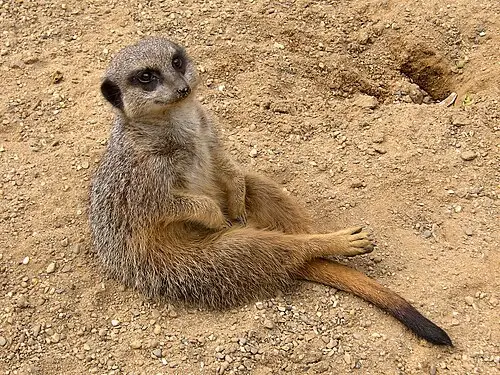
 📸 Photo
Photo: Hans Hillewaert · CC BY-SA 4.0 · Wikimedia Commons Source
Meerkat
Suricata suricatta (Meerkat · ミーアキャット)
💡 Everyday Comparisons for Size, Mass & Speed
- 💡 Its head-to-rump length of 29 cm is almost equal to the long side of an A4 sheet of paper (29.7 cm) (Comparison).
- 💡 Its weight of 725 g is similar to one and a half 500 mL bottles of water (Comparison).
- 💡 At the Smithsonian's National Zoo, it is fed carnivore meat mix, cat food, apples, root vegetables, mealworms, crickets, and earthworms.
Reference standards: coach bus ~12 m, mid-size car ~4.9 m, compact car ~1 t, basketball hoop 3.05 m, credit card 8.56 cm.
Site-computed relative index from recorded values; not a formal scientific metric.
📖 1. Overview
The Meerkat is a small burrowing mongoose of arid southern Africa that forms cooperative groups called "mobs" of 2–50 individuals to forage together.
🦴 2. Anatomy & Morphology
It has a slender body and 4 long, curved claws on each foot, averaging 15 mm on the forefeet and 8 mm on the hind feet. Dark patches around its eyes reduce glare from the sun.
🔍 3. Ecology & Behavior
Insects make up 82% of its diet, supplemented by spiders, centipedes, millipedes, reptiles, amphibians, and birds. Usually only one dominant pair breeds while helpers care for the young, and the breeding season coincides with the rainy season.
🇰🇷 4. Connection to Korea
No direct record connecting this species to Korea has been found.
📚 Sources & References
- • IUCN Red List LC (2015) — https://www.iucnredlist.org/species/41624/45209377
- • IUCN Red List category LC — latest assessment at iucnredlist.org
- • mammaldiversity.org — 1006070
- • iucnredlist.org — 45209377
- • wikidata.org — Q134015
- • commons.wikimedia.org — File:Meerkat (Suricata suricatta).jpg
- • animaldiversity.org — Suricata suricatta
- • nationalzoo.si.edu — meerkat
- • Silhouette: PhyloPic — Andy Wilson · CC0 1.0
Recorded dimensions are widely cited representative estimates from public literature and may vary by study or specimen.