 📸 Photo
Photo: Brian.gratwicke · CC BY-SA 3.0 · Wikimedia Commons Source
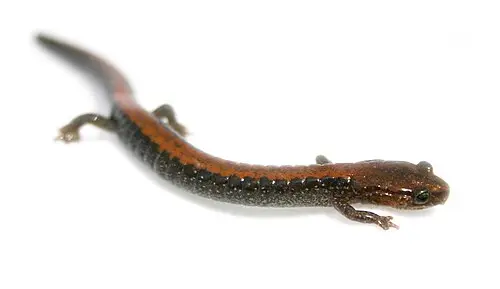
Eastern Red-backed Salamander
Plethodon cinereus (Eastern Red-backed Salamander · セアカサラマンダー)
💡 Everyday Comparisons for Size, Mass & Speed
- 💡 Its average weight of 0.5 g is only about one-tenth that of a single sheet of A4 paper (about 5 g) (Comparison).
- 💡 By catching pests on the forest floor, it can help regulate pest populations (ADW, 'Positive Impacts').
- 💡 At the Smithsonian's National Zoo, it is fed a mix of crickets, fruit flies, bean beetles, isopods, springtails, and black worms.
Reference standards: coach bus ~12 m, mid-size car ~4.9 m, compact car ~1 t, basketball hoop 3.05 m, credit card 8.56 cm.
Site-computed relative index from recorded values; not a formal scientific metric.
📖 1. Overview
The Eastern Red-backed Salamander is a small salamander living under fallen leaves, stones, and logs on the floor of eastern North American forests, breathing through its skin because it lacks lungs. It is listed as Least Concern (LC, 2022 assessment) on the IUCN Red List.
🦴 2. Anatomy & Morphology
Measuring 5.7–12.7 cm in body length with an average weight of 0.5 g, it has no lungs and relies on its moist skin for breathing. It occurs in two color forms—a 'red-backed' phase with a red stripe on a gray or black body and a stripe-free 'lead-backed' phase—has 5 toes on its hind feet, and can drop its tail when threatened and regrow a new one.
🔍 3. Ecology & Behavior
It quickly darts out its tongue to catch a variety of invertebrates including mites, spiders, insects, centipedes, snails, and earthworms, with the period after rain being optimal for foraging. In spring, females lay 3–14 eggs in underground crevices or beneath rotting wood and coil around them to guard them, and the young hatch directly without a larval stage.
🇰🇷 4. Connection to Korea
No direct record connecting this species to Korea has been found.
📚 Sources & References
- • IUCN Red List LC (2022) — https://www.iucnredlist.org/species/59334/193391260
- • IUCN Red List category LC — latest assessment at iucnredlist.org
- • catalogueoflife.org — 6W283
- • iucnredlist.org — 193391260
- • wikidata.org — Q1092717
- • commons.wikimedia.org — File:Plethodon cinereus1.jpg
- • animaldiversity.org — Plethodon cinereus
- • nationalzoo.si.edu — eastern-red-backed-salamander
- • Silhouette: PhyloPic — Beth Reinke · CC0 1.0
Recorded dimensions are widely cited representative estimates from public literature and may vary by study or specimen.