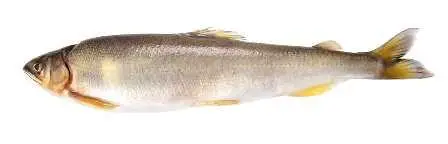
 📸 Photo
Photo: OAS at Japanese Wikipedia · CC BY-SA 3.0 · Wikimedia Commons Source
Ayu sweetfish
Plecoglossus altivelis (Ayu sweetfish · アユ)
💡 Everyday Comparisons for Size, Mass & Speed
- 💡 Korea Policy Briefing (2012) introduces the ayu sweetfish as having a clean taste without fishiness and a watermelon-like aroma, eaten raw, deep-fried, grilled, or in soup.
- 💡 Its common size of 15 cm is similar to a single ballpoint pen (about 14 cm) (Comparison).
Reference standards: coach bus ~12 m, mid-size car ~4.9 m, compact car ~1 t, basketball hoop 3.05 m, credit card 8.56 cm.
📖 1. Overview
The ayu sweetfish is a fish living from western Hokkaido in Japan to the Korean Peninsula, Taiwan, and China, migrating between rivers and the sea and favoring clear river water.
🦴 2. Anatomy & Morphology
Its common size is 15 cm in body length, and when it reaches about 6–9 cm it scrapes algae off stones with its small teeth.
🔍 3. Ecology & Behavior
Newly hatched larvae feed on plankton, young fish ascending rivers in spring eat algae and insects, and eggs attached to sand and gravel hatch in 14–20 days.
🇰🇷 4. Connection to Korea
It is listed on the National List of Species of Korea (National Institute of Biological Resources (NIBR)), and Korea Policy Briefing introduces the ayu sweetfish living in Grade 1 clean water as a summer delicacy in season from June to August.
📚 Sources & References
- • IUCN Red List DD (2012) — https://www.iucnredlist.org/species/62222/3110058
- • IUCN Red List category DD — latest assessment at iucnredlist.org
- • catalogueoflife.org — 4K2R5
- • iucnredlist.org — 3110058
- • 국가생물종목록(국립생물자원관) ktsn 120000057726 — https://species.nibr.go.kr/home/mainHome.do?cont_link=009&subMenu=009002&contCd=009002&ktsn=120000057726
- • wikidata.org — Q642906
- • commons.wikimedia.org — File:Sweetfish, Plecoglossus altivelis.jpg
- • fishbase.se — Plecoglossus-altivelis.html
- • species.nibr.go.kr — general-search
- • korea.kr — healthView.do
- • Silhouette: PhyloPic — Cee Nell · CC0 1.0
Recorded dimensions are widely cited representative estimates from public literature and may vary by study or specimen.