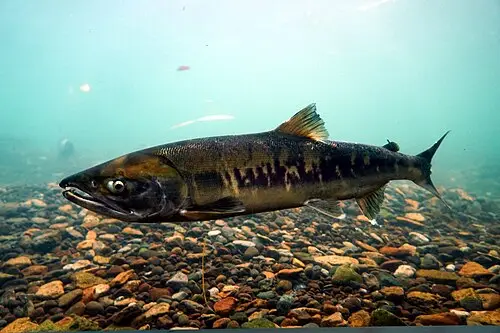
 📸 Photo
Photo: Focus Saranpat Ouilapan · CC0 · Wikimedia Commons Source
Chum salmon
Oncorhynchus keta (Chum salmon · サケ)
💡 Everyday Comparisons for Size, Mass & Speed
- 💡 Its maximum fork length of 1 m is the same length as one 1 m ruler (Comparison).
- 💡 Its maximum weight of 18.1 kg is slightly lighter than a 20 kg bag of rice (Comparison).
- 💡 Caught chum salmon is mainly canned and also sold fresh, salted and dried, smoked, or frozen, and is eaten steamed, fried, or broiled (FishBase).
- 💡 In Korea, it ascends rivers north of Gangneung that flow into the East Sea (National List of Species of Korea).
Reference standards: coach bus ~12 m, mid-size car ~4.9 m, compact car ~1 t, basketball hoop 3.05 m, credit card 8.56 cm.
Site-computed relative index from recorded values; not a formal scientific metric.
📖 1. Overview
The chum salmon is a fish that lives in the North Pacific and returns in autumn to the river where it was born to spawn, ranking among the larger Pacific salmon. Both males and females die after spawning.
🦴 2. Anatomy & Morphology
Its body is cylindrical and streamlined with a very large mouth, normally dark bluish-black on the back and silvery white on the belly. During the spawning season, reddish-purple markings appear on its flanks, and males develop strongly hooked jaws and enlarged canine-like teeth.
🔍 3. Ecology & Behavior
In the sea, it feeds on crustaceans such as copepods and krill, as well as squid and small fish. Around September–November, males and females ascend rivers, build a spawning bed together, lay eggs, and cover them with gravel for protection, without feeding in freshwater.
🇰🇷 4. Connection to Korea
It is listed on the National List of Species of Korea and spawns mainly in rivers north of Gangneung that flow into the East Sea.
📚 Sources & References
- • IUCN Red List LC (2024) — https://www.iucnredlist.org/species/202637/18236268
- • IUCN Red List category LC — latest assessment at iucnredlist.org
- • catalogueoflife.org — 49JF6
- • iucnredlist.org — 18236268
- • 국가생물종목록(국립생물자원관) ktsn 120000057744 — https://species.nibr.go.kr/home/mainHome.do?cont_link=009&subMenu=009002&contCd=009002&ktsn=120000057744
- • wikidata.org — Q475211
- • commons.wikimedia.org — File:Oncorhynchus keta 336279549.jpg
- • fishbase.se — Oncorhynchus-keta.html
- • species.nibr.go.kr — mainHome.do
- • fisheries.noaa.gov — chum-salmon
- • Silhouette: PhyloPic — Margot Michaud · CC0 1.0 (Congeneric silhouette — Oncorhynchus mykiss)
Recorded dimensions are widely cited representative estimates from public literature and may vary by study or specimen.