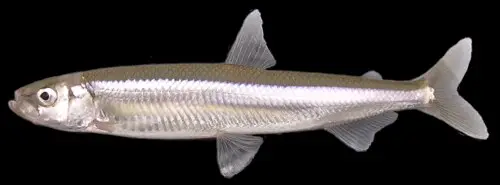
 📸 Photo
Photo: René Reyes · Public domain · Wikimedia Commons Source
Japanese smelt
Hypomesus nipponensis (Japanese smelt · ワカサギ)
💡 Everyday Comparisons for Size, Mass & Speed
- 💡 A body length of 15 cm is similar to the length of a new ballpoint pen (Comparison).
- 💡 Caught from autumn through spring, it is used for tempura, raw fish dishes, and spicy stews (National List of Species of Korea).
- 💡 Its Korean name was given with the meaning of “living under the ice,” and it is also called Gongeo, Baengeo, or Dongeo (“frozen fish”) (Korean names) (National List of Species of Korea).
Reference standards: coach bus ~12 m, mid-size car ~4.9 m, compact car ~1 t, basketball hoop 3.05 m, credit card 8.56 cm.
📖 1. Overview
The Japanese smelt is a slender fish with a body so translucent that its insides can be seen clearly, inhabiting most dams and reservoirs in Korea. It is also distributed in Japan, Russia, and Alaska.
🦴 2. Anatomy & Morphology
The body is slender, elongated, and laterally compressed, with an adipose fin between the dorsal and caudal fins. A broad silvery-white longitudinal band runs along the middle of each side, and breeding males develop weak tubercles on the head, scales, and fins.
🔍 3. Ecology & Behavior
It feeds mainly on zooplankton and chironomid larvae. It stays in the deep parts of lakes in summer, then spawns on gravel bottoms of shallow streams in April and May before dying.
🇰🇷 4. Connection to Korea
It is listed in the National List of Species of Korea and lives in medium to large lakes, dams, and reservoirs nationwide. Lake populations in Korea are said to have originated from sea-run individuals caught ascending rivers and released into reservoirs, where they became landlocked and continued through generations.
📚 Sources & References
- • IUCN Red List LC (2021) — https://www.iucnredlist.org/species/159715391/159715398
- • IUCN Red List category LC — latest assessment at iucnredlist.org
- • catalogueoflife.org — 3NXD8
- • iucnredlist.org — 159715398
- • 국가생물종목록(국립생물자원관) ktsn 120000057716 — https://species.nibr.go.kr/home/mainHome.do?cont_link=009&subMenu=009002&contCd=009002&ktsn=120000057716
- • wikidata.org — Q1039191
- • commons.wikimedia.org — File:Wakasagi Adult (70mm).tif
- • species.nibr.go.kr — mainHome.do
- • Silhouette: PhyloPic — Fidji Berio · CC0 1.0 (Related taxon silhouette — Osmerus eperlanus)
Recorded dimensions are widely cited representative estimates from public literature and may vary by study or specimen.