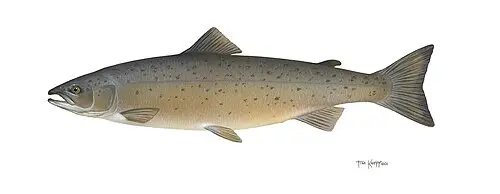
 📸 Photo
Photo: Timothy Knepp, U.S. Fish and Wildlife Service · Public domain · Wikimedia Commons Source
Atlantic salmon
Salmo salar (Atlantic salmon · タイセイヨウサケ)
💡 Everyday Comparisons for Size, Mass & Speed
- 💡 Its maximum total length of 1.5 m reaches above an adult's waist (Comparison).
- 💡 Its maximum weight of 46.8 kg is the weight of two and a half 20 kg bags of rice (Comparison).
- 💡 Famous among anglers and prized as a food fish, its aquaculture through sea cages and hatcheries has spread worldwide (ADW).
Reference standards: coach bus ~12 m, mid-size car ~4.9 m, compact car ~1 t, basketball hoop 3.05 m, credit card 8.56 cm.
Site-computed relative index from recorded values; not a formal scientific metric.
📖 1. Overview
The Atlantic salmon is a salmon living in the North Atlantic and is the only salmon native to the Atlantic Ocean. Its IUCN assessment is Near Threatened (NT, 2023).
🦴 2. Anatomy & Morphology
Its body is spindle-shaped, thick in the middle, tapered at both ends, and slightly flattened laterally. The head is small at about one-fifth of the body length, and unlike Pacific salmon, it has fewer than 13 rays in its anal fin.
🔍 3. Ecology & Behavior
After growing in fresh water for 2–3 years, it migrates to the sea, where it feeds on krill and fish such as herring, smelt, and small cod. In October and November, females dig nests (redds) in river gravel bottoms to lay eggs, and adults do not feed after returning to fresh water.
🇰🇷 4. Connection to Korea
No direct record connecting this species to Korea has been found.
📚 Sources & References
- • IUCN Red List NT (2023) — https://www.iucnredlist.org/species/19855/67373433
- • IUCN Red List category NT — latest assessment at iucnredlist.org
- • catalogueoflife.org — 6XCXT
- • iucnredlist.org — 67373433
- • wikidata.org — Q188879
- • commons.wikimedia.org — File:Atlantic salmon fish.jpg
- • fishbase.se — Salmo-salar.html
- • animaldiversity.org — Salmo salar
- • fisheries.noaa.gov — atlantic-salmon
- • Silhouette: PhyloPic — author not recorded · CC0 1.0
Recorded dimensions are widely cited representative estimates from public literature and may vary by study or specimen.