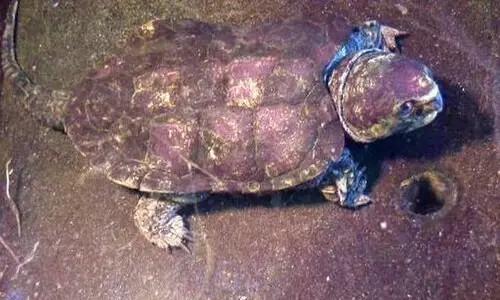
 📸 Photo
Photo: luki · CC BY-SA 3.0 · Wikimedia Commons Source
Big-headed Turtle
Platysternon megacephalum (Big-headed Turtle · オオアタマガメ)
💡 Everyday Comparisons for Size, Mass & Speed
- 💡 A total length of 40 cm including the tail is about 1.3 times the long side of an A4 sheet of paper (about 30 cm) (Comparison).
- 💡 It was once common in food markets of southern China and has also been sold in the pet trade and as tourist souvenirs (positive impacts on humans in ADW).
Reference standards: coach bus ~12 m, mid-size car ~4.9 m, compact car ~1 t, basketball hoop 3.05 m, credit card 8.56 cm.
📖 1. Overview
The Big-headed Turtle is a uniquely shaped turtle living in rocky mountain streams, with a head and tail nearly as large as its body. Its IUCN assessment is Critically Endangered (CR) as of 2021.
🦴 2. Anatomy & Morphology
Its triangular head is oversized and cannot be withdrawn into its shell, and its skull is solid bone. Its carapace is relatively flat and nearly rectangular.
🔍 3. Ecology & Behavior
A carnivore that moves along stream bottoms and among low shrubs at night to eat fish, mollusks, and worms with its strong beak and jaws. It spends the day under rocks or underwater, is a poor swimmer but well adapted for climbing rocks, and lays 1–2 white eggs at a time.
🇰🇷 4. Connection to Korea
No direct record connecting this species to Korea has been found.
📚 Sources & References
- • IUCN Red List CR (2021) — https://www.iucnredlist.org/species/17585/1423706
- • IUCN Red List category CR — latest assessment at iucnredlist.org
- • catalogueoflife.org — 4JZ39
- • iucnredlist.org — 1423706
- • wikidata.org — Q754035
- • commons.wikimedia.org — File:Zolw wielkoglowy.jpg
- • animaldiversity.org — Platysternon megacephalum
- • Silhouette: PhyloPic — John Edward Gray · Public Domain Mark 1.0
Recorded dimensions are widely cited representative estimates from public literature and may vary by study or specimen.