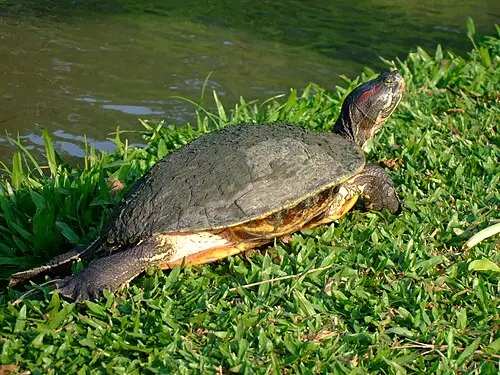
 📸 Photo
Photo: Happyswissman · CC BY 3.0 · Wikimedia Commons Source
Pond Slider
Trachemys scripta (Pond Slider · アカミミガメ)
💡 Everyday Comparisons for Size, Mass & Speed
- 💡 A female's maximum carapace length of 29 cm is almost the same size as the long side of an A4 sheet of paper (about 29.7 cm) (Comparison).
- 💡 Pond Sliders brought in as pets and released now live in rivers and ponds across Korea (National List of Species of Korea).
- 💡 According to ADW, it has long been sold in large numbers as a pet in the United States, and an estimated 500,000 pet turtles are exported from the United States to Japan each year.
Reference standards: coach bus ~12 m, mid-size car ~4.9 m, compact car ~1 t, basketball hoop 3.05 m, credit card 8.56 cm.
Site-computed relative index from recorded values; not a formal scientific metric.
📖 1. Overview
The Pond Slider is a semi-aquatic freshwater turtle native to North America, living in slow-moving waters with basking spots such as ponds, lakes, and rivers. Sold as a pet, it has spread to many parts of the world.
🦴 2. Anatomy & Morphology
It has a red stripe right behind each eye, a dark green carapace with yellow stripes, and webbing between its hind toes. Males grow front claws about twice as long as those of females, while females are larger than males.
🔍 3. Ecology & Behavior
Juveniles are carnivorous, eating insects, crustaceans, tadpoles, and fish, but shift as they grow to an omnivorous diet centered on aquatic plants. It basks for long periods, lays 5–22 eggs a year, and has a wild lifespan of about 20 years.
🇰🇷 4. Connection to Korea
Its domestic distribution is listed as 'nationwide' in the National List of Species of Korea. Individuals brought in as pets now live in lakes, rivers, and pools across the country.
📚 Sources & References
- • IUCN Red List LC (2011) — https://www.iucnredlist.org/species/22028/97429935
- • IUCN Red List category LC — latest assessment at iucnredlist.org
- • catalogueoflife.org — C8JV7
- • iucnredlist.org — 97429935
- • 국가생물종목록(국립생물자원관) ktsn 120000059456 — https://species.nibr.go.kr/home/mainHome.do?cont_link=009&subMenu=009002&contCd=009002&ktsn=120000059456
- • wikidata.org — Q142985
- • commons.wikimedia.org — File:Red-eared Slider Thailand.JPG
- • animaldiversity.org — Trachemys scripta
- • species.nibr.go.kr — mainHome.do
- • Silhouette: PhyloPic — DataBase Center for Life Science (DBCLS) · CC BY 4.0
Recorded dimensions are widely cited representative estimates from public literature and may vary by study or specimen.