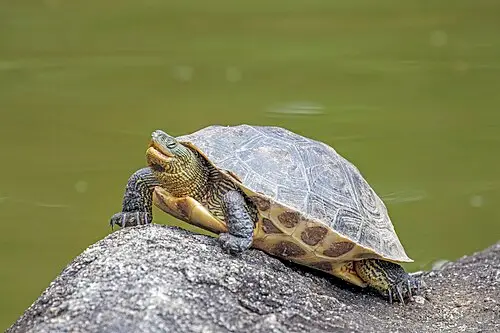
 📸 Photo
Photo: Charles J. Sharp · CC BY-SA 4.0 · Wikimedia Commons Source
Chinese Striped-necked Turtle
Mauremys sinensis (Chinese Striped-necked Turtle · ハナガメ)
💡 Everyday Comparisons for Size, Mass & Speed
- 💡 A maximum carapace length of about 28 cm is slightly shorter than the long side of an A4 sheet (about 30 cm), and an average mass of 1.2 kg is slightly lighter than a 1.5 L bottle of water (Comparison).
- 💡 Used for food and traditional medicine in its native range and popular as a pet, over 1 million individuals are traded annually (U.S. Fish and Wildlife Service).
- 💡 Abandoned or released pet turtles have established populations in Korea as well as Hong Kong and Italy (U.S. Fish and Wildlife Service).
Reference standards: coach bus ~12 m, mid-size car ~4.9 m, compact car ~1 t, basketball hoop 3.05 m, credit card 8.56 cm.
Site-computed relative index from recorded values; not a formal scientific metric.
📖 1. Overview
The Chinese Striped-necked Turtle is a freshwater turtle living in southern China, Taiwan, Laos, and northern Vietnam that favors standing or slow-moving waters such as ponds and reservoirs. Depleted by overharvesting, its IUCN status is Critically Endangered (CR) as of 2021.
🦴 2. Anatomy & Morphology
Newly hatched young have a carapace length of about 32 mm and weigh 6.6 g, growing to a maximum carapace length of nearly 280 mm.
🔍 3. Ecology & Behavior
Omnivorous, females favor plants whereas males prefer carrion or easy-to-catch animals. It basks, feeds, and overwinters along watersides, and females come ashore to lay eggs.
🇰🇷 4. Connection to Korea
It is listed in the National List of Species of Korea, and U.S. Fish and Wildlife Service records note that introduced populations have become established in Korea.
📚 Sources & References
- • IUCN Red List CR (2021) — https://www.iucnredlist.org/species/15026/547319
- • IUCN Red List category CR — latest assessment at iucnredlist.org
- • catalogueoflife.org — 3YFWN
- • iucnredlist.org — 547319
- • 국가생물종목록(국립생물자원관) ktsn 120000090379 — https://species.nibr.go.kr/home/mainHome.do?cont_link=009&subMenu=009002&contCd=009002&ktsn=120000090379
- • wikidata.org — Q1124688
- • commons.wikimedia.org — File:Chinese stripe-necked turtle (Mauremys sinensis) Bach M
- • fws.gov — Ecological-Risk-Screening-Summary-Chinese-Striped-necked-Tur
- • Silhouette: PhyloPic — Kawahara Keiga · Public Domain Mark 1.0 (Congeneric silhouette — Mauremys reevesii)
Recorded dimensions are widely cited representative estimates from public literature and may vary by study or specimen.