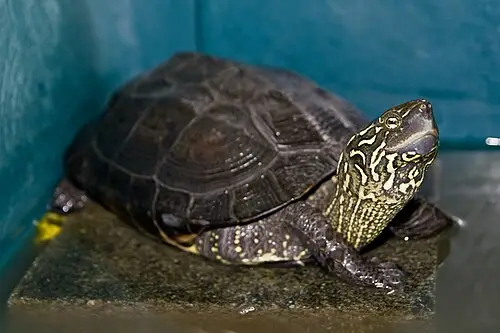
 📸 Photo
Photo: Σ64 · CC BY 3.0 · Wikimedia Commons Source
Reeves' Turtle
Mauremys reevesii (Reeves' Turtle · クサガメ)
🇰🇷 Class II endangered wildlife (Korea) · Natural Monument (Korea) «Reeves' Turtle»
💡 Everyday Comparisons for Size, Mass & Speed
- 💡 Clues to distinguish it from other turtles in park ponds: Reeves' Turtle has three raised longitudinal ridges on its carapace and yellow stripes on its neck. In Hong Kong reservoirs, introduced Pond Sliders have reportedly taken over much of its habitat.
- 💡 Its average carapace length of 12.5 cm is slightly shorter than a ballpoint pen (about 14 cm) (Comparison).
Reference standards: coach bus ~12 m, mid-size car ~4.9 m, compact car ~1 t, basketball hoop 3.05 m, credit card 8.56 cm.
📖 1. Overview
Reeves' Turtle is a freshwater turtle living in rivers, ponds, and swamps of East Asia including Korea, China, and Taiwan.
🦴 2. Anatomy & Morphology
Its carapace is dark brown with three raised longitudinal ridges, and its unhinged plastron is yellowish-brown with dark blotches. Its head is dark grey with yellow stripes on the neck, and its toes are webbed.
🔍 3. Ecology & Behavior
An omnivore that eats small animals such as fish, frogs, and snails along with aquatic plants and carrion. Spending most of its time in water but frequently coming ashore, it lays eggs whose incubation temperature determines the sex of the hatchlings.
🇰🇷 4. Connection to Korea
In Korea, it is designated as Class II endangered wildlife (Korea), and on March 17, 2005 it was designated as a Natural Monument (Korea) under the name "Namsaengi" (Korean name).
📚 Sources & References
- • IUCN Red List EN (2011) — https://www.iucnredlist.org/species/170502/97431862
- • 멸종위기 야생생물 Ⅱ급 · 천연기념물 «남생이» — 국가생물종목록(국립생물자원관) ktsn 120000059453 — https://species.nibr.go.kr/home/mainHome.do?cont_link=009&subMenu=009002&contCd=009002&ktsn=120000059453
- • IUCN Red List category EN — latest assessment at iucnredlist.org
- • Korean protection status: Class II endangered wildlife (Korea) · Natural Monument (Korea) «Reeves' Turtle»
- • catalogueoflife.org — 3YFWL
- • iucnredlist.org — 97431862
- • 국가생물종목록(국립생물자원관) ktsn 120000059453 — https://species.nibr.go.kr/home/mainHome.do?cont_link=009&subMenu=009002&contCd=009002&ktsn=120000059453
- • heritage.go.kr — culSelectDetail.do
- • wikidata.org — Q495153
- • commons.wikimedia.org — File:Chinemys reevesii 02.jpg
- • biosch.hku.hk — Mauremys reevesii.html
- • reptile-database.reptarium.cz — species
- • species.nibr.go.kr — general-search
- • pmc.ncbi.nlm.nih.gov — PMC9436999
- • Silhouette: PhyloPic — Kawahara Keiga · Public Domain Mark 1.0
Recorded dimensions are widely cited representative estimates from public literature and may vary by study or specimen.