 📸 Photo
Photo: Cuora at English Wikipedia · CC BY-SA 3.0 · Wikimedia Commons Source
Snake-eating Turtle
Cuora flavomarginata (Snake-eating Turtle · セマルハコガメ)
💡 Everyday Comparisons for Size, Mass & Speed
- 💡 Its maximum length of 19 cm is slightly shorter than the short side of an A4 sheet (21 cm), and its maximum mass of 1 kg equals two 500 mL bottles of water (Comparison).
- 💡 It is collected for food, traditional Chinese medicine, and the pet trade, though its medicinal value is not supported by research and such harvesting threatens populations (benefit to humans noted by ADW).
Reference standards: coach bus ~12 m, mid-size car ~4.9 m, compact car ~1 t, basketball hoop 3.05 m, credit card 8.56 cm.
Site-computed relative index from recorded values; not a formal scientific metric.
📖 1. Overview
The Snake-eating Turtle is a semi-aquatic turtle moving between land and water, living in hilly evergreen forests, low-elevation grasslands, rice paddies, and streams. Its IUCN status is Endangered (EN) as of 2000.
🦴 2. Anatomy & Morphology
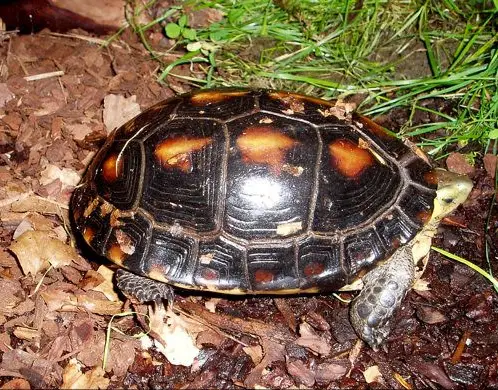
Its carapace is high-domed and dark brown with red and pale yellow stripes, while the top of its head is pale green with a bright yellow line behind each eye. Females are larger, whereas males have broader, thicker tails.
🔍 3. Ecology & Behavior
An omnivore that eats snails, slugs, earthworms, berries, and leaves. It is most active from early April to late October, hibernates under logs or brush in winter, and lays 1–4 eggs per clutch.
🇰🇷 4. Connection to Korea
No direct record connecting this species to Korea has been found.
📚 Sources & References
- • IUCN Red List EN (2000) — https://www.iucnredlist.org/species/5960/97359069
- • IUCN Red List category EN — latest assessment at iucnredlist.org
- • catalogueoflife.org — 6BRPF
- • iucnredlist.org — 97359069
- • wikidata.org — Q304894
- • commons.wikimedia.org — File:Evelynae.jpg
- • animaldiversity.org — Cuora flavomarginata
- • Silhouette: PhyloPic — Idamara Fernandes Santa Cruz · CC0 1.0 (Related taxon silhouette — Rhinoclemmys punctularia)
Recorded dimensions are widely cited representative estimates from public literature and may vary by study or specimen.