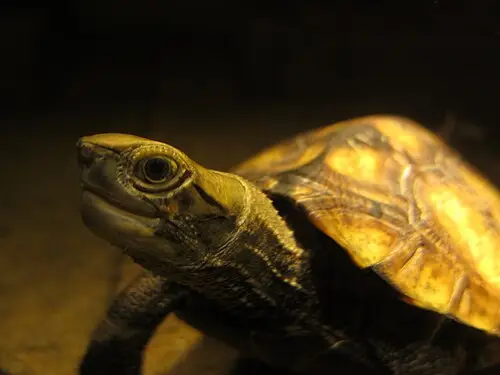
 📸 Photo
Photo: Ceiocaciaca · Public domain · Wikimedia Commons Source
Japanese Pond Turtle
Mauremys japonica (Japanese Pond Turtle · ニホンイシガメ)
💡 Everyday Comparisons for Size, Mass & Speed
- 💡 A female's maximum length of 21 cm equals the short side of an A4 sheet (21 cm), and a female's mass of about 0.75 kg equals one and a half 500 mL bottles of water (Comparison).
- 💡 In Japan, where its hatchlings were long familiar under the name "Zenigame" (coin turtle), declining numbers have led to its listing on the Ministry of the Environment Red List (2017) (Ministry of the Environment of Japan).
- 💡 Invasive species such as the Pond Slider, also common in Korea, are treated as a conservation issue in Japan for taking over the habitat and food of this native turtle (Ministry of the Environment of Japan).
Reference standards: coach bus ~12 m, mid-size car ~4.9 m, compact car ~1 t, basketball hoop 3.05 m, credit card 8.56 cm.
Site-computed relative index from recorded values; not a formal scientific metric.
📖 1. Overview
The Japanese Pond Turtle is a turtle endemic to Japan, living in the upper to middle reaches of rivers, ponds, and rice paddies across Honshu, Shikoku, Kyushu, and nearby islands. Its hatchlings were fondly called "Zenigame" (coin turtles) in Japan.
🦴 2. Anatomy & Morphology
Its carapace is yellowish-brown with a serrated rear margin, and it is characterized by a long tail. Females are much larger than males.
🔍 3. Ecology & Behavior
An omnivore that eats aquatic and terrestrial insects, fish, amphibians, snails, crustaceans, plant fruits and leaves, aquatic plants, and algae. It lays 1–12 eggs at a time, and its numbers are declining as it competes for food and habitat with the introduced Pond Slider.
🇰🇷 4. Connection to Korea
No direct record connecting this species to Korea has been found.
📚 Sources & References
- • IUCN Red List NT (2000) — https://www.iucnredlist.org/species/39612/97370705
- • IUCN Red List category NT — latest assessment at iucnredlist.org
- • catalogueoflife.org — 3YFWC
- • iucnredlist.org — 97370705
- • wikidata.org — Q1361877
- • commons.wikimedia.org — File:Mauremys japonica fase.jpg
- • env.go.jp — akamimigame06.pdf
- • Silhouette: PhyloPic — Kawahara Keiga · Public Domain Mark 1.0 (Congeneric silhouette — Mauremys reevesii)
Recorded dimensions are widely cited representative estimates from public literature and may vary by study or specimen.