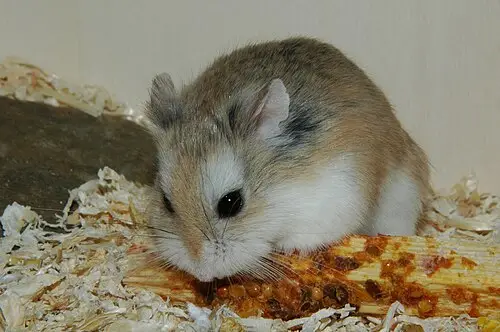
 📸 Photo
Photo: Bullet · CC BY-SA 3.0 · Wikimedia Commons Source
Desert Hamster
Phodopus roborovskii (Desert Hamster · ロボロフスキーハムスター)
💡 Everyday Comparisons for Size, Mass & Speed
- 💡 Its maximum weight of 27.2 g equals three and a half Korean 500-won coins (about 7.7 g each), and its length of 10.6 cm is about 2 cm longer than the long side of a credit card (about 8.6 cm) (Comparison).
- 💡 It was first bred at the Moscow Zoo and only entered the pet market after the 1990s. Because of its high activity level and tendency to get stressed easily, its popularity as a pet is limited (Animal Diversity Web).
Reference standards: coach bus ~12 m, mid-size car ~4.9 m, compact car ~1 t, basketball hoop 3.05 m, credit card 8.56 cm.
Site-computed relative index from recorded values; not a formal scientific metric.
📖 1. Overview
The Desert Hamster is the smallest of all hamsters and lives by digging burrows in sandy semi-deserts and grasslands.
🦴 2. Anatomy & Morphology
Matching its small body, it has a delicate skull and a long, slender snout. It has one pair each of upper and lower incisors that grow throughout life, and it carries food in its cheek pouches.
🔍 3. Ecology & Behavior
It mainly eats plant seeds, carrying them in its cheek pouches to its burrow. It generally lives alone and is shy, hiding when another hamster approaches.
🇰🇷 4. Connection to Korea
No direct record connecting this species to Korea has been found.
📚 Sources & References
- • IUCN Red List LC (2016) — https://www.iucnredlist.org/species/17036/115139633
- • IUCN Red List category LC — latest assessment at iucnredlist.org
- • mammaldiversity.org — 1002214
- • iucnredlist.org — 115139633
- • wikidata.org — Q729420
- • commons.wikimedia.org — File:Phodopus roborovskii side.jpg
- • animaldiversity.org — Phodopus roborovskii
- • Silhouette: PhyloPic — Edwin Price · CC0 1.0 (Related taxon silhouette — Oligoryzomys nigripes)
Recorded dimensions are widely cited representative estimates from public literature and may vary by study or specimen.