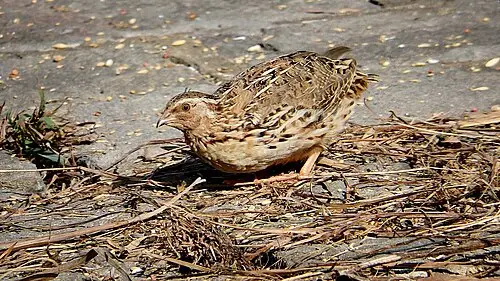
 📸 Photo
Photo: 孫鋒 林 from Taipei, Taiwan · CC BY-SA 2.0 · Wikimedia Commons Source
Japanese Quail
Coturnix japonica (Japanese Quail · ウズラ)
💡 Everyday Comparisons for Size, Mass & Speed
- 💡 One quail egg averages 7.6 g, about one-eighth (1/8) the weight of a chicken egg (about 60 g) (Comparison).
- 💡 Japanese quail and their eggs are eaten as food by people, and the birds are also kept in aviaries (ADW, 'Economic Importance for Humans: Positive').
- 💡 In winter, it can be seen in open places such as rice paddies and grassy fields (National List of Species of Korea, ADW).
Reference standards: coach bus ~12 m, mid-size car ~4.9 m, compact car ~1 t, basketball hoop 3.05 m, credit card 8.56 cm.
Site-computed relative index from recorded values; not a formal scientific metric.
📖 1. Overview
The Japanese quail is a small pheasant-family bird living in open fields. In Korea, it is a common winter visitor and a summer visitor that breeds rarely.
🦴 2. Anatomy & Morphology
Its body length is 20 cm, with many white and black streaks on a buff back and a white eyebrow stripe reaching the back of the neck. Males have a black forehead and crown and a rusty-red neck and upper back, whereas females generally lack red on the breast and black markings on the throat.
🔍 3. Ecology & Behavior
It eats many grass seeds and in summer also catches small worms and insect larvae. It makes its nest by scraping a hollow in the ground and lining it with dry grass, and instead of flying far it beats its short wings rapidly to fly about 50 m.
🇰🇷 4. Connection to Korea
It is listed on the National List of Species of Korea as distributed nationwide, a common winter visitor and a rare breeding summer visitor in Korea.
📚 Sources & References
- • IUCN Red List NT (2025) — https://www.iucnredlist.org/species/22678949/218902058
- • IUCN Red List category NT — latest assessment at iucnredlist.org
- • doi.org — avilist.v2026
- • iucnredlist.org — 218902058
- • 국가생물종목록(국립생물자원관) ktsn 120000001407 — https://species.nibr.go.kr/home/mainHome.do?cont_link=009&subMenu=009002&contCd=009002&ktsn=120000001407
- • wikidata.org — Q716869
- • commons.wikimedia.org — File:Coturnix japonica, Yehliu, Taiwan 1.jpg
- • species.nibr.go.kr — mainHome.do
- • animaldiversity.org — Coturnix japonica
- • Silhouette: PhyloPic — Matías Muñoz · CC0 1.0
Recorded dimensions are widely cited representative estimates from public literature and may vary by study or specimen.