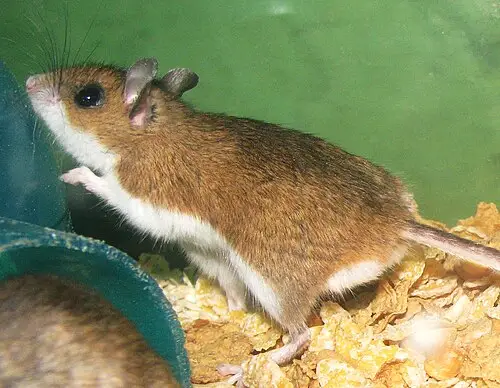
 📸 Photo
Photo: 6th Happiness · CC BY-SA 3.0 · Wikimedia Commons Source
Eastern Deermouse
Peromyscus maniculatus (Eastern Deermouse · シカシロアシネズミ)
💡 Everyday Comparisons for Size, Mass & Speed
- 💡 Its maximum weight of 24 g is about the weight of three 500-won coins (about 7.7 g each), and its length of 22.2 cm is similar to the short side of A4 paper (21 cm) (Comparison).
- 💡 It serves as prey for various carnivores, including valuable fur-bearing mammals, and consumes insects regarded as pests (Animal Diversity Web).
Reference standards: coach bus ~12 m, mid-size car ~4.9 m, compact car ~1 t, basketball hoop 3.05 m, credit card 8.56 cm.
Site-computed relative index from recorded values; not a formal scientific metric.
📖 1. Overview
The Eastern Deermouse is a small mouse widespread across North America, living in many environments from alpine zones to deserts.
🦴 2. Anatomy & Morphology
No larger than a house mouse, it has a round, slender build, a pointed nose, and large, jet-black eyes. Its ears are large with sparse fur, and its forelimbs are shorter than its hind limbs.
🔍 3. Ecology & Behavior
Active mainly at night, it is an omnivore that eats insects, seeds, fruits, flowers, and nuts. In cold regions it caches food in secret granaries in autumn, and its gestation period is 22–31 days.
🇰🇷 4. Connection to Korea
No direct record connecting this species to Korea has been found.
📚 Sources & References
- • IUCN Red List LC (2016) — https://www.iucnredlist.org/species/16672/22360898
- • IUCN Red List category LC — latest assessment at iucnredlist.org
- • mammaldiversity.org — 1002307
- • iucnredlist.org — 22360898
- • wikidata.org — Q649836
- • commons.wikimedia.org — File:DiGangi-Deermouse.jpg
- • animaldiversity.org — Peromyscus maniculatus
- • Silhouette: PhyloPic — Nina Skinner · CC BY 3.0 (Congeneric silhouette — Peromyscus leucopus)
Recorded dimensions are widely cited representative estimates from public literature and may vary by study or specimen.