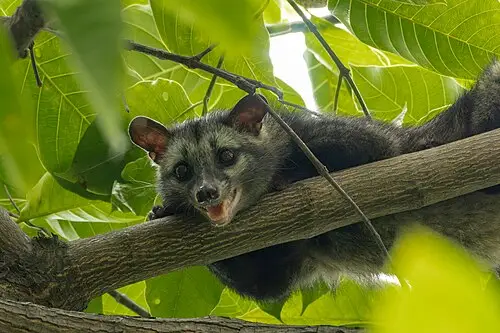
 📸 Photo
Photo: Tisha Mukherjee · CC BY-SA 4.0 · Wikimedia Commons Source
Northern Palm Civet
Paradoxurus hermaphroditus (Northern Palm Civet · パームシベット)
💡 Everyday Comparisons for Size, Mass & Speed
- 💡 A body length of 71 cm is about 2.4 times the long side of an A4 sheet of paper (29.7 cm) (Comparison).
- 💡 An average weight of 3 kg is similar to one and a half 2-liter bottles of water (Comparison).
- 💡 The name "toddy cat" comes from toddy, a fermented drink made from palm flower sap that it likes to drink, and it also catches rats in fruit trees and village gardens (ADW).
Reference standards: coach bus ~12 m, mid-size car ~4.9 m, compact car ~1 t, basketball hoop 3.05 m, credit card 8.56 cm.
Site-computed relative index from recorded values; not a formal scientific metric.
📖 1. Overview
The Northern Palm Civet, also called the palm civet or toddy cat, is a nocturnal, tree-dwelling civet that also visits urban gardens and orchards. Because it is an adaptable opportunist that eats whatever is available, it is often compared to the North American raccoon.
🦴 2. Anatomy & Morphology
It has an elongated body, short legs, and a tail nearly as long as its head and body combined. It has a pointed nose, large dark eyes, large pointed ears, and short, coarse fur that is usually black or gray.
🔍 3. Ecology & Behavior
It selects ripe fruits such as figs, mangoes, bananas, rambutans, and papayas, enjoys palm flower sap, and also eats rodents, birds, insects, and eggs. Resting in tree hollows or rock crevices by day, it can breed year-round and produce up to two litters a year.
🇰🇷 4. Connection to Korea
No direct record connecting this species to Korea has been found.
📚 Sources & References
- • IUCN Red List LC (2024) — https://www.iucnredlist.org/species/41693/259352474
- • IUCN Red List category LC — latest assessment at iucnredlist.org
- • mammaldiversity.org — 1006100
- • iucnredlist.org — 259352474
- • wikidata.org — Q18764
- • commons.wikimedia.org — File:Asian palm civet in Rabindra Sarobar October 2024 by Ti
- • animaldiversity.org — Paradoxurus hermaphroditus
- • Silhouette: PhyloPic — Margot Michaud · CC0 1.0
Recorded dimensions are widely cited representative estimates from public literature and may vary by study or specimen.