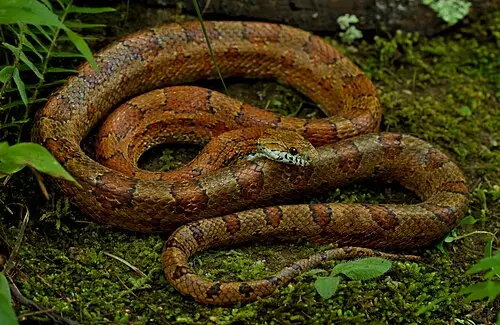
 📸 Photo
Photo: Peter Paplanus · CC BY 2.0 · Wikimedia Commons Source
Red Cornsnake
Pantherophis guttatus (Red Cornsnake · コーンスネーク)
💡 Everyday Comparisons for Size, Mass & Speed
- 💡 An average weight of 900 g is lighter than a 1 kg bag of sugar (Comparison).
- 💡 Animal Diversity Web notes that the Red Cornsnake is a popular pet for reptile enthusiasts, fed mice, rats, or chicks in captivity, and is generally safe even for households with children.
Reference standards: coach bus ~12 m, mid-size car ~4.9 m, compact car ~1 t, basketball hoop 3.05 m, credit card 8.56 cm.
Site-computed relative index from recorded values; not a formal scientific metric.
📖 1. Overview
The Red Cornsnake is a non-venomous, mild-tempered snake that lives in a variety of habitats from forests and fields to suburban yards.
🦴 2. Anatomy & Morphology
Large blotches run along its back, and its belly often has a black-and-white checkered pattern. Its base color is brown and reddish orange, and selective breeding in captivity has produced many color morphs including white, yellow, and black.
🔍 3. Ecology & Behavior
It kills prey by constriction; more than half of its diet consists of rodents such as cotton rats and white-footed mice, and it also climbs trees to swallow bird eggs. From month 5 to early month 7, it lays 10–15 eggs (up to 30) in tree stumps or burrows.
🇰🇷 4. Connection to Korea
No direct record connecting this species to Korea has been found.
📚 Sources & References
- • IUCN Red List LC (2016) — https://www.iucnredlist.org/species/63863/71740603
- • IUCN Red List category LC — latest assessment at iucnredlist.org
- • catalogueoflife.org — 75LTS
- • iucnredlist.org — 71740603
- • wikidata.org — Q754747
- • commons.wikimedia.org — File:Kornnatter (Pantherophis guttatus), Seitenansicht.jpg
- • animaldiversity.org — Pantherophis guttatus
- • Silhouette: PhyloPic — Alex Slavenko · CC0 1.0 (Related taxon silhouette — Elaphe quatuorlineata)
Recorded dimensions are widely cited representative estimates from public literature and may vary by study or specimen.